

What a man does for pay is of little significance. What he is, as a sensitive instrument responsive to the world's beauty, is everything!
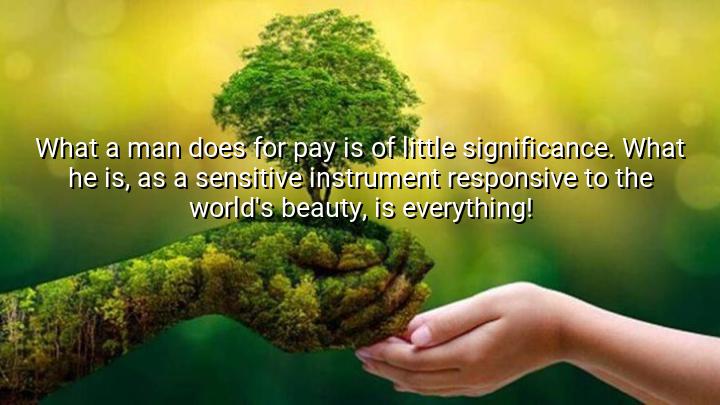




The quote "What a man does for pay is of little significance. What he is, as a sensitive instrument responsive to the world's beauty, is everything!" by H. P. Lovecraft challenges the traditional focus on work and financial success as measures of a person’s value. Lovecraft, a writer best known for his contributions to horror and cosmicism, argues that the true worth of a person lies not in their professional accomplishments or income, but in their ability to experience and connect with the beauty of the world. For Lovecraft, a person's sensitivity and appreciation of beauty define their essence more than external achievements.
Lovecraft's distinction between what a person does for pay and what they are as an individual highlights the idea that material success and societal expectations are less important than emotional and intellectual depth. His use of the term "sensitive instrument" suggests that humans should be attuned to the subtleties of life and capable of appreciating the aesthetic and emotional aspects of the world around them. For Lovecraft, the ability to engage deeply with the world's beauty—whether through nature, art, or relationships—is the truest form of human fulfillment.
The quote also speaks to Lovecraft's broader philosophical views, particularly his cosmicism—the belief that humans are insignificant in the vastness of the universe. While his works often focused on the darker aspects of human existence, this quote emphasizes the potential for beauty and emotional connection, suggesting that the human experience’s worth lies in its sensitivity to the world rather than in tangible, material success. It reflects a spiritual or intellectual richness that transcends economic or social achievements.
Ultimately, H. P. Lovecraft’s quote encourages us to focus on the intrinsic value of individuals, emphasizing the human capacity to respond to the world's beauty as the true measure of one's life. By rejecting the significance of monetary gain and social status, Lovecraft calls for a deeper connection to the world, one that appreciates the non-material, emotional, and aesthetic dimensions of human experience.

AAdministratorAdministrator
Welcome, honored guests. Please leave a comment, we will respond soon