

Welcome, wild harbinger of spring! To this small nook of earth; Feeling and fancy fondly cling, Round thoughts which owe their birth, To thee, and to the humble spot, Where chance has fixed thy lowly lot.
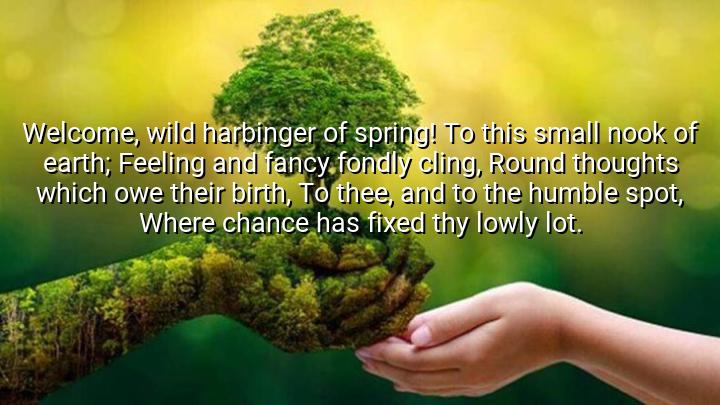




The quote "Welcome, wild harbinger of spring! To this small nook of earth; Feeling and fancy fondly cling, Round thoughts which owe their birth, To thee, and to the humble spot, Where chance has fixed thy lowly lot." comes from Bernard Barton, the 19th-century English poet often referred to as the “Quaker Poet.” In these lines, Barton greets a wild harbinger of spring—likely a flower or bird—celebrating its arrival in a modest, perhaps overlooked, nook of earth. His tone is one of reverence for nature’s quiet beauty and the emotional inspiration it provides.
The meaning of the passage lies in the deep connection between nature, feeling, and imagination. Barton suggests that small, humble aspects of the natural world can evoke powerful thoughts and emotions. By calling the creature or bloom a harbinger of spring, he highlights its symbolic role as a sign of renewal and hope. The mention of chance placing it in a lowly lot underscores the idea that beauty and significance can thrive anywhere, even in the most unassuming places.
The origin of this poetic sentiment reflects Barton’s Romantic-era influences, when writers often drew inspiration from nature’s cycles and the emotional responses they stirred in the human heart. His Quaker background also shaped his appreciation for simplicity, humility, and quiet reflection, all of which are evident in these lines. The celebration of a single spot of earth mirrors the Romantic belief that meaning can be found in intimate, personal encounters with the natural world rather than in grand or dramatic settings.
Ultimately, Barton’s words serve as a reminder that even the smallest elements of nature can inspire creativity and fancy. They invite the reader to notice and cherish the quiet signs of change—those delicate, living symbols that carry with them the promise of spring and the renewal of life.

AAdministratorAdministrator
Welcome, honored guests. Please leave a comment, we will respond soon