

We would fight not for the political future of a distant city, rather for principles whose destruction would ruin the possibility of peace and security for the peoples of the earth.
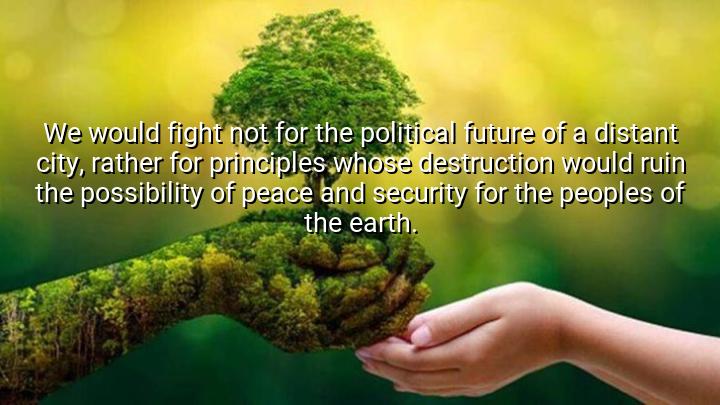




In this quote, Neville Chamberlain, the British Prime Minister at the time of World War II, emphasizes the importance of principles over political interests in the context of global peace and security. He suggests that the fight is not about the political future of any one nation or city, but about defending core values that are essential for the survival and stability of the entire world. The principles he refers to likely involve concepts such as democracy, freedom, and international cooperation—values that, if undermined, could threaten global peace.
Chamberlain’s reference to the destruction of these principles highlights the grave consequences of allowing ideologies or actions that challenge these foundational values. He believes that the erosion of these principles would not only endanger individual nations but would also jeopardize the broader security of all nations. His words reflect the urgency of standing up for values that protect the well-being of all peoples of the earth, not just those in particular countries.
The quote reflects a globalist perspective, advocating for international unity in the face of threats to peace. Chamberlain is calling for a fight that transcends national borders, implying that the true goal of the conflict was the preservation of a secure and peaceful world order, rather than mere political gain or territorial expansion. This vision speaks to the idea that true security and peace can only be achieved when nations unite around common, universal principles.
Ultimately, Chamberlain’s quote illustrates his belief in the importance of defending moral principles in times of international conflict. It emphasizes that the stakes of war and diplomacy are not just about political outcomes for individual countries but about protecting values that ensure the long-term peace and stability of the world. The quote reflects a call for solidarity and principled action in the face of global challenges.

AAdministratorAdministrator
Welcome, honored guests. Please leave a comment, we will respond soon