

We were poor, but we didn't know it. There were no government bureaus in those days presuming to determine where poorness begins and ends, but I don't remember ever being hungry.
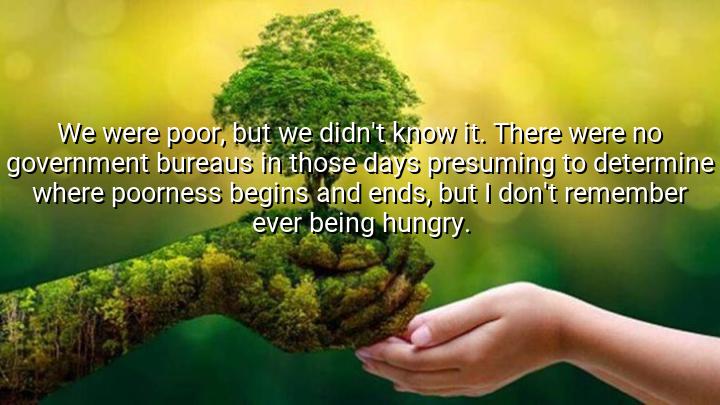




The quote by Paul Harvey, "We were poor, but we didn't know it. There were no government bureaus in those days presuming to determine where poorness begins and ends, but I don't remember ever being hungry," reflects his perspective on poverty and self-sufficiency. Harvey is suggesting that, despite having limited financial resources, he did not feel the sense of deprivation or hardship that we often associate with poverty today. He contrasts his own experience with the modern bureaucratic systems that define and address poverty through government assistance programs, highlighting that in his day, people often lived without the need for external validation or support of their economic status.
Harvey’s words emphasize the idea that poverty is not solely defined by material wealth, but also by the resilience and sense of community that can exist even among those with little. His recollection that he never felt hungry suggests that basic needs were still being met, despite the lack of government intervention. Harvey seems to be lamenting the rise of a system where poverty is quantified and managed by the state, which, in his view, may lead to a sense of dependency rather than personal empowerment.
The origin of the quote comes from Paul Harvey, a well-known American radio broadcaster and commentator, famous for his distinctive voice and conservative viewpoints. Harvey often reflected on the values of past generations, particularly those related to self-reliance and individual responsibility. His comment about poverty and government intervention is consistent with his broader critique of the expanding role of government in people’s lives, particularly in the welfare state.
In essence, Harvey’s quote highlights his belief in the importance of personal resilience and community support over government intervention. He suggests that people were able to get by without official definitions of poverty and without extensive welfare programs, relying instead on their own resourcefulness. His statement serves as a critique of modern policies that, in his view, overcomplicate or exacerbate the problem of poverty by institutionalizing it.

AAdministratorAdministrator
Welcome, honored guests. Please leave a comment, we will respond soon