

We shall never be able to remove suspicion and fear as potential causes of war until communication is permitted to flow, free and open, across international boundaries.
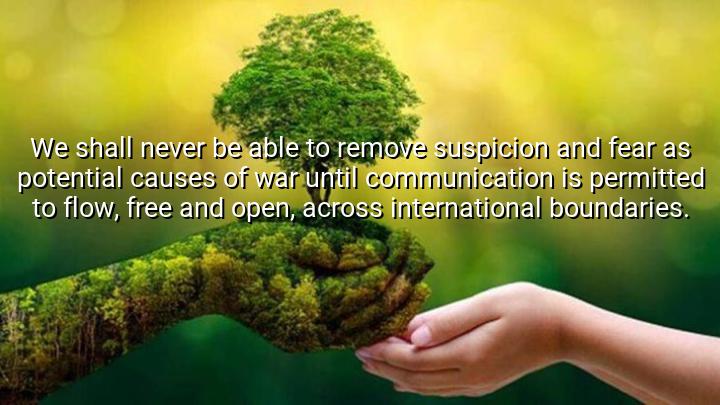




The quote by Harry S. Truman — “We shall never be able to remove suspicion and fear as potential causes of war until communication is permitted to flow, free and open, across international boundaries.” — underscores the critical role of free and open communication in fostering peace and international understanding. Truman argues that fear and suspicion—the emotional drivers behind many conflicts—can only be resolved through transparent dialogue and the exchange of information across national borders. Without this openness, nations remain isolated in mistrust, leading to increased chances of misunderstanding and ultimately war.
The origin of this quote comes from Truman’s presidency during the early years of the Cold War, a period marked by intense geopolitical tension between the United States and the Soviet Union. As the world was recovering from World War II, global leaders recognized that information control, propaganda, and censorship were tools often used to fuel conflict. Truman, known for his advocacy of democratic values and transparency, emphasized that true peace required not just diplomacy, but a free flow of communication among peoples and governments.
By stressing the need for communication to cross international boundaries, Truman highlights the importance of cross-cultural understanding, journalism, education, and public discourse in building trust between nations. He believed that walls of secrecy and isolation only deepen divisions, while open channels allow for the kind of mutual respect and cooperation that make war less likely. In this sense, communication becomes not just a tool, but a safeguard of global stability.
Ultimately, this quote remains relevant in today’s world, where misinformation, media silos, and political polarization continue to pose threats to peace. Truman's message reminds us that creating a safer world depends not just on treaties or weapons control, but on encouraging dialogue, transparency, and the free exchange of ideas—cornerstones of any peaceful and democratic society.

AAdministratorAdministrator
Welcome, honored guests. Please leave a comment, we will respond soon