

We often call a certainty a hope, to bring it luck.
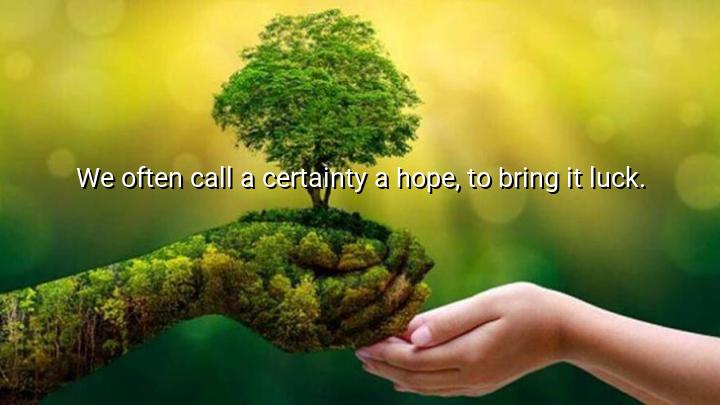




Elizabeth Bibesco’s quote, “We often call a certainty a hope, to bring it luck,” highlights the human tendency to reframe certainty as hope in order to invoke a sense of positivity or good fortune. Bibesco suggests that by labeling something that is likely or certain to happen as a “hope,” we might feel that we are somehow influencing its outcome for the better. This manipulation of language serves as a psychological tool to foster optimism and confidence, even when the outcome is already almost predetermined.
The quote points to the idea that hope is not always about uncertainty or desire for something unattainable, but sometimes it’s about transforming a known outcome into something more ambiguous and open to possibility. By using the word “hope,” we create an emotional buffer, making it easier to deal with expectations, as though our wishes or beliefs could shape the future, even if it’s already set. It reflects a superstitious or optimistic need to see control in situations where it may not truly exist.
Elizabeth Bibesco, a writer and poet known for her insight into human nature, often explored themes of emotion and psychology in her work. This quote reflects her keen understanding of how people often use language and belief to cope with the pressures of certainty and fate. Her words suggest that in the face of inevitable events, humans seek to create a more hopeful or positive frame to make the process more palatable.
Ultimately, Bibesco’s quote reveals how language can shape our perceptions of reality, influencing not only how we communicate but also how we experience the world. By calling a certainty a hope, we reframe our perspective, allowing us to feel more empowered and hopeful even when the outcome is already known, highlighting the complex interplay between emotion, belief, and language.

AAdministratorAdministrator
Welcome, honored guests. Please leave a comment, we will respond soon