

We especially need imagination in science. It is not all mathematics, nor all logic, but it is somewhat beauty and poetry.
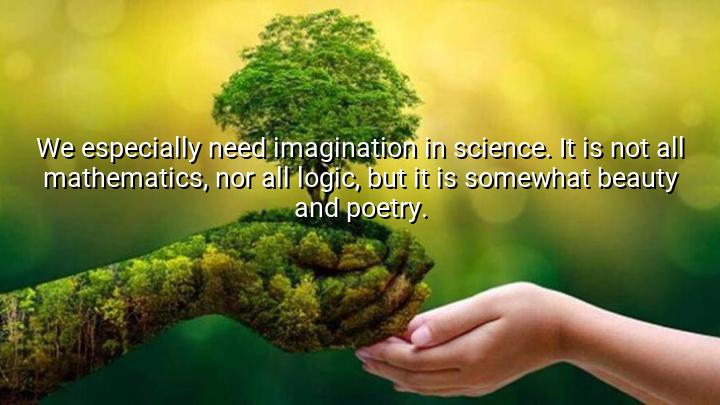




The quote "We especially need imagination in science. It is not all mathematics, nor all logic, but it is somewhat beauty and poetry" by Maria Mitchell emphasizes the importance of creativity and imagination in scientific discovery. Mitchell, a pioneering American astronomer, suggests that while mathematics and logic are crucial in science, they are not the only components. She argues that imagination plays a key role in scientific progress, enabling scientists to think beyond what is immediately observable and explore new possibilities. This view highlights the dynamic relationship between the rational and creative aspects of scientific work.
Mitchell's statement challenges the traditional perception that science is purely technical and analytical, focusing solely on data and empirical evidence. She recognizes that beauty and poetry are essential elements that drive scientific curiosity and discovery. Imagination allows scientists to dream up new theories, envision the unseen, and ask questions that might lead to groundbreaking discoveries. In this sense, science becomes not just a collection of facts but a form of art that requires a creative approach to interpreting the world.
The reference to beauty and poetry reflects Mitchell's belief that science is not only about finding answers but also about appreciating the wonder and mystery of the universe. Much like a poet finds beauty in words, a scientist finds beauty in the patterns and structures of nature. This metaphor underscores the idea that science, at its core, is an expression of human creativity, seeking to understand and appreciate the world around us in profound and artistic ways.
Ultimately, Mitchell’s quote encourages a more holistic view of science, one that values both the logical and imaginative aspects of inquiry. It suggests that the most significant scientific breakthroughs often come from the ability to imagine new possibilities and see beyond the limits of current knowledge. By incorporating imagination into scientific endeavors, we can open up new realms of understanding and innovation.

AAdministratorAdministrator
Welcome, honored guests. Please leave a comment, we will respond soon