

We can't have full knowledge all at once. We must start by believing; then afterwards we may be led on to master the evidence for ourselves.
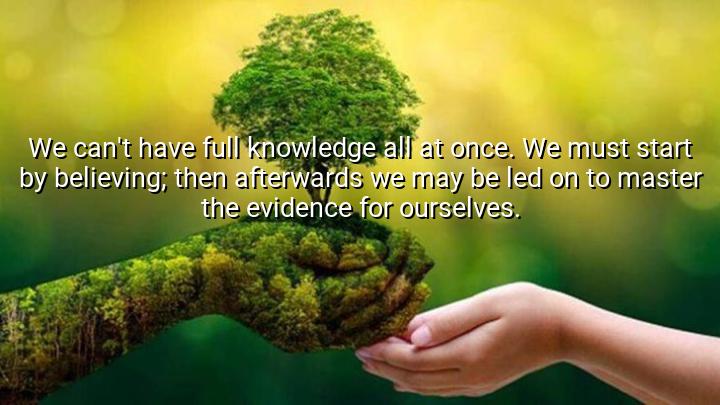




The quote by Thomas Aquinas—“We can't have full knowledge all at once. We must start by believing; then afterwards we may be led on to master the evidence for ourselves”—explores the relationship between faith and reason. Aquinas suggests that the pursuit of knowledge is a gradual process: initial belief or trust serves as a foundation, which can later be reinforced and deepened through study, evidence, and rational inquiry. Knowledge, he emphasizes, is not instantaneous but develops over time.
A central idea in the quote is the concept of learning in stages. Aquinas argues that starting with belief allows individuals to engage with complex truths that might otherwise be inaccessible. As understanding grows, this belief is strengthened by evidence and reasoning, creating a more robust and informed grasp of reality. Faith, in this context, is both a starting point and a guide toward deeper intellectual comprehension.
The origin of this quote comes from Thomas Aquinas, a 13th-century Italian philosopher and theologian, who extensively wrote on scholasticism, natural law, and the integration of faith and reason. Aquinas believed that human understanding and divine truth were interconnected, and that reason could illuminate and confirm the principles initially accepted through belief.
Ultimately, the quote conveys that knowledge is a progressive journey from belief to understanding. Aquinas emphasizes that faith and reason are complementary: belief initiates the pursuit of truth, while evidence and rational reflection allow individuals to master and internalize knowledge, ensuring both intellectual and spiritual growth.

AAdministratorAdministrator
Welcome, honored guests. Please leave a comment, we will respond soon