

We are aware that globalization doesn't mean global friendship but global competition and, therefore, conflict. That doesn't mean we will all destroy each other, but it is no happy global village, either.
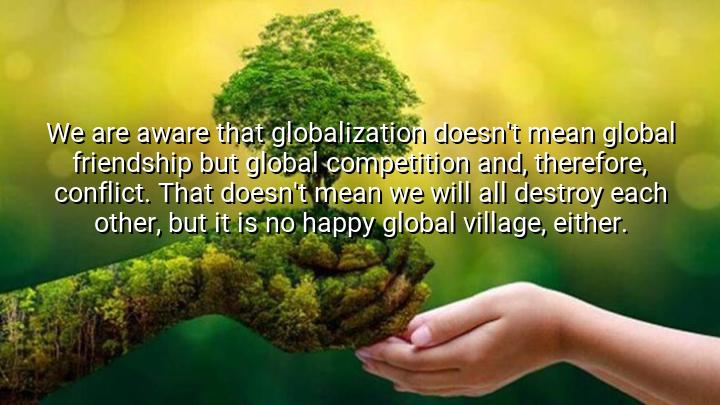




The quote "We are aware that globalization doesn't mean global friendship but global competition and, therefore, conflict. That doesn't mean we will all destroy each other, but it is no happy global village, either" by René Girard, a French historian and philosopher, reflects his critical view on the effects of globalization. Girard suggests that while globalization brings people from different cultures and nations into closer contact, it does not automatically result in harmonious relationships or mutual understanding. Instead, globalization often leads to increased competition for resources, power, and influence, which can result in conflict.
Girard’s perspective challenges the idealistic notion of a "happy global village," where friendship and cooperation define international relations. He acknowledges that globalization connects the world more than ever before, but the interconnectedness does not necessarily lead to peace or unity. Instead, it often exacerbates competition between nations, economic systems, and individuals, each vying for dominance. This competition can lead to conflicts, as societies struggle to assert their interests and defend their resources.
At the same time, Girard does not suggest that globalization will lead to the complete destruction of humanity. Rather, he points out that while global competition may create friction and tension, it does not necessarily mean total devastation. There is still the possibility of coexistence, but it is a coexistence marked by conflict and rivalry, not a utopian world of peace and harmony.
In conclusion, René Girard's quote provides a sobering perspective on globalization. While it has brought the world closer together, it has also amplified competition and conflict rather than fostering global friendship. Girard’s view challenges the notion of a peaceful global community and underscores the complex, sometimes adversarial nature of globalization.

AAdministratorAdministrator
Welcome, honored guests. Please leave a comment, we will respond soon