

Unless one is able to live fully in the present, the future is a hoax.
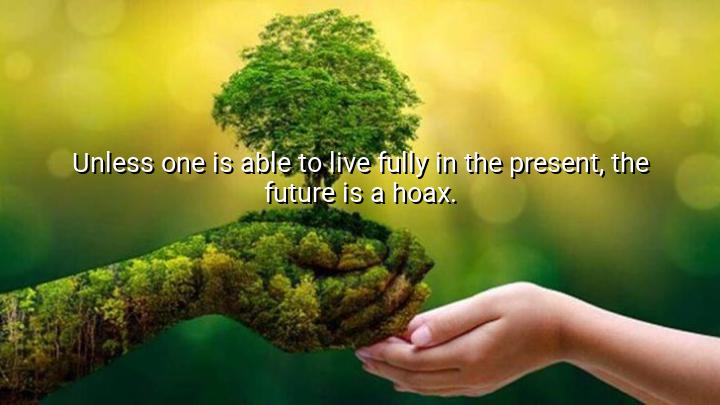




The quote by Alan Watts, a British philosopher known for his work on Eastern philosophy and the interpretation of Zen and Taoist teachings, emphasizes the importance of living fully in the present. Watts argues that if one is unable to truly immerse themselves in the current moment, the future becomes irrelevant and illusory. By focusing on the present, we make life meaningful, whereas constantly worrying about or planning for the future can distract us from the only moment we truly control—now.
Watts' statement suggests that the concept of the future is often misunderstood or overemphasized. Rather than seeing it as something to be predicted or controlled, he believes that it is the present, lived experience that is most important. If we are always looking ahead, we miss the richness and vibrancy of life unfolding in the present. This philosophy aligns with the idea that true peace and fulfillment come from mindfulness and being completely attuned to the present moment.
The origin of this quote is tied to Watts' teachings on mindfulness, impermanence, and the transient nature of existence. As a philosopher who studied and taught about meditation and the importance of awareness in daily life, Watts often stressed that the present is the only time in which we truly exist. His teachings draw from Eastern spiritual traditions, which emphasize the ephemeral nature of time and the importance of living fully in each moment.
Ultimately, Watts’ quote serves as a reminder to embrace the present moment and to see it as the foundation of a meaningful life. It urges us to stop focusing solely on the future or the past, which are often beyond our control, and to instead live with intention and awareness in the now. Through this mindset, the future becomes a natural progression of the present, rather than a distant or illusory concept.

AAdministratorAdministrator
Welcome, honored guests. Please leave a comment, we will respond soon