

Ultimately we may still ask, why can't humans design a perfect society?
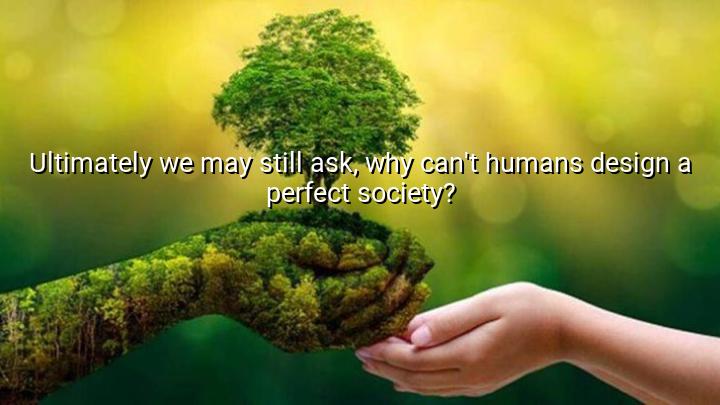




In this quote, Robert Shea raises the question of whether it is possible for humans to design a perfect society. He reflects on the inherent challenges and limitations of creating a flawless system that addresses all aspects of human nature, society, and governance. Shea’s rhetorical question suggests that, despite our best efforts, the complexity of human behavior and societal dynamics may always prevent us from achieving perfection.
Shea’s statement speaks to the fundamental difficulties in designing a utopia. Even with the advancement of philosophy, technology, and social science, creating a perfect society would require overcoming deep-rooted issues like inequality, conflict, and imperfect human instincts. His question invites reflection on whether true perfection is attainable, or if such an ideal is merely an aspiration rather than a practical reality.
The origin of this quote likely stems from Shea’s interest in social and political theory, where he often explored complex issues related to governance, power, and the flaws within human societies. As a writer, Shea frequently examined themes of utopianism and idealism, acknowledging the inherent tension between visionary goals and the real-world obstacles that make them difficult to achieve. His work often questioned the viability of perfect systems and the nature of human progress.
Ultimately, Shea’s quote challenges the assumption that perfection can be designed or constructed. It underscores the idea that, while striving for a better society is a noble goal, humans must confront the limitations of reality and human nature in any attempt to create an ideal world. The quest for a perfect society may be endless, but it also encourages critical reflection on how we approach social design and human flourishing.

AAdministratorAdministrator
Welcome, honored guests. Please leave a comment, we will respond soon