

Together let us desire, conceive, and create the new structure of the future, which will embrace architecture and sculpture and painting in one unity and which will one day rise toward Heaven from the hands of a million workers like the crystal symbol of a new faith.
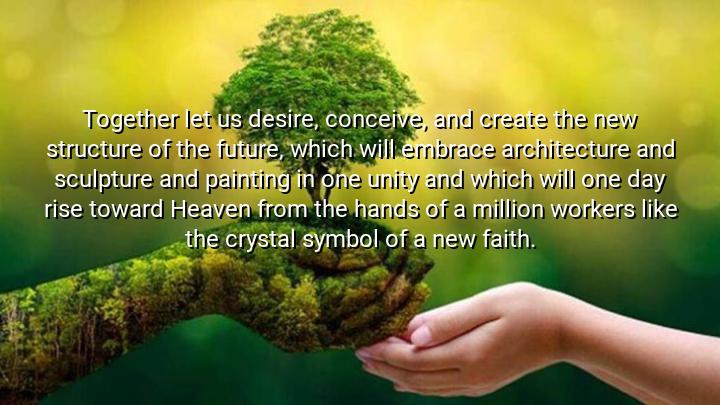




The quote by Walter Gropius, "Together let us desire, conceive, and create the new structure of the future..." captures the visionary spirit of the Bauhaus movement, which Gropius founded in 1919. In this call to action, Gropius invites artists, architects, and craftspeople to work collectively to shape a new kind of creative unity—a holistic design approach that fuses architecture, sculpture, and painting into a single, harmonious whole. This reflects his belief in collaboration and the integration of all the arts under the roof of architecture.
By imagining a “new structure of the future”, Gropius expresses a desire to transcend traditional artistic boundaries and create a modern, idealistic vision for society. He envisions a world where design is not fragmented into isolated disciplines but united by a common purpose and social mission. The image of this structure “rising toward Heaven” like a “crystal symbol of a new faith” is deeply symbolic, evoking both spiritual aspiration and a belief in the transformative power of design.
This quote originates from the Bauhaus Manifesto, a foundational document that laid out the philosophy behind the revolutionary German school of art and design. At a time when industrialization was reshaping society, Gropius sought to reconnect art and craftsmanship in service of the modern world. The crystal symbol becomes a metaphor for clarity, purity, and a new social order, where beauty and function coexist for the benefit of all.
Ultimately, Gropius’s words remain a powerful statement of idealist modernism. He saw design not merely as aesthetic expression, but as a tool to improve life, uplift humanity, and shape the future. His vision continues to influence generations of designers and architects who believe in the unifying power of the arts to build a better, more integrated world.

KNNguyen Thi Kim Ngan
Gropius’s vision reminds me of cathedrals—spaces where architecture, sculpture, and painting historically converged. But instead of religious institutions, he seems to be imagining a secular temple to modernity. Was he trying to recapture the unity of the arts in a new, industrial age? If so, how does technology fit into this picture? Can digital tools today help realize his dream of a unified, collective creative future—or does tech fragment things even further?
0A03-Ng Anh
There’s something epic and communal about this quote that really resonates with me. The idea of collective creativity feels empowering, especially today when creative industries can often be hyper-individualized. But who exactly are the ‘million workers’? Does this vision respect the contributions of every builder, or is it idealizing labor without addressing inequality? I’d love to know how Gropius envisioned fairness and ownership in such massive collaborative efforts.
QQUANGNGHIEMDINH
I find this quote incredibly moving, almost utopian. But it makes me wonder how practical such a vision is. Can artistic unity actually survive in a system dominated by budgets, zoning laws, and commercial interests? Where is the space for experimental unity between architecture, sculpture, and painting in the 21st century? Or is this kind of artistic dream more of an inspirational compass than a real blueprint?
NVNguyen Vy
There’s something deeply spiritual about this quote, especially with the imagery of rising toward Heaven and the idea of a ‘new faith.’ Is Gropius suggesting that modern design could replace traditional religion as a source of shared belief and purpose? That’s a bold idea. I’m curious—was he proposing a secular spirituality through architecture, or is this just metaphorical language to convey the emotional power of unified creative work?
T8NGUYEN THI THANH TRUC 8a
This quote reads like a manifesto, full of hope and visionary energy. But the mention of 'a million workers' makes me pause. Is Gropius romanticizing labor, or was he genuinely advocating for an egalitarian creative process? I’d love to understand how this vision fits into the broader context of Bauhaus values. Was this unity he described about aesthetics, politics, or both? And how inclusive was it, really?