

To suppose that any form of government will secure liberty or happiness without any virtue in the people, is a chimerical idea.
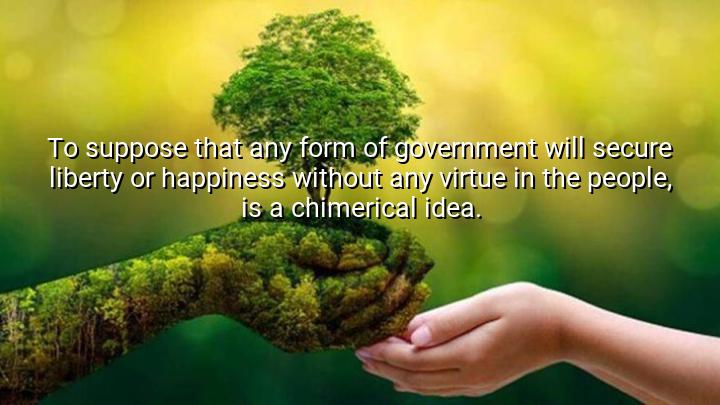




In this quote, James Madison, one of the Founding Fathers of the United States and the fourth President, argues that liberty and happiness cannot be sustained by any form of government if the people do not possess virtue. Madison emphasizes that a government, no matter how well-designed, relies on the moral character and personal responsibility of its citizens to function properly. He believes that virtue—such as honesty, integrity, and a sense of civic duty—is essential for the success of any political system, as a corrupt or immoral populace will inevitably lead to the downfall of even the best institutions.
Madison’s statement reflects his view of human nature and his political philosophy, which was deeply influenced by the idea of self-government. He believed that democracy required an active and virtuous citizenry to work effectively. A government that is designed to protect liberty must also be supported by citizens who understand and value their role in maintaining a just and free society. Without virtue, the government could easily be corrupted, and the ideals of liberty and happiness would be undermined.
The quote suggests that governments are not self-sustaining; their success depends on the moral quality of the people they serve. Madison was wary of the idea that government alone could guarantee freedom and prosperity. Instead, he argued that the character of the people—whether they adhere to principles of virtue—is the true foundation of a stable and just society. This idea aligns with his broader philosophy of checks and balances and the belief that institutions must be accompanied by responsible, morally grounded citizens to prevent abuses of power.
The origin of this quote can be traced to Madison’s writings, particularly his contributions to the Federalist Papers, where he discussed the importance of a well-structured government and the need for civic virtue to sustain the Republic. Madison believed that a democratic government would only work if the people were virtuous enough to act in the best interests of the nation, rather than succumbing to selfish desires or external influences. This quote encapsulates his foundational belief that a thriving society requires both strong institutions and strong individuals.

AAdministratorAdministrator
Welcome, honored guests. Please leave a comment, we will respond soon