

To be without some of the things you want is an indispensable part of happiness.
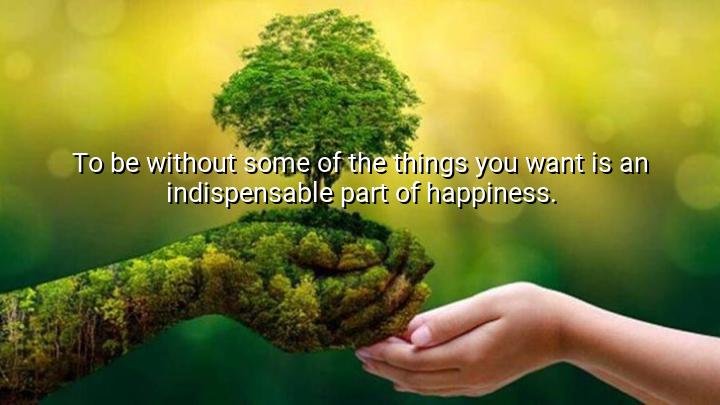




The quote by Bertrand Russell, "To be without some of the things you want is an indispensable part of happiness," suggests that contentment is not solely dependent on fulfilling all of our desires and wants. Russell argues that true happiness arises from the acceptance of the things we cannot have, recognizing that the absence of some desires can lead to a deeper appreciation of what we already possess. By acknowledging that not having everything we want is a natural part of life, we are able to focus more on gratitude and inner peace.
The origin of this quote lies in Bertrand Russell, a British philosopher, logician, and social critic who wrote extensively on topics such as ethics, philosophy, and the nature of happiness. Known for his works like The Conquest of Happiness, Russell often explored how societal expectations and personal desires shape human well-being. This quote reflects his belief that happiness is not about material wealth or achieving every goal, but about finding peace in our limitations and learning to live with them.
Russell’s insight challenges the modern notion that happiness is directly tied to the acquisition of more—more wealth, possessions, or achievements. Instead, he emphasizes the importance of finding balance and satisfaction in life by recognizing that happiness can exist even in the presence of unmet desires. This idea aligns with a more stoic philosophy, which teaches that happiness comes not from external circumstances but from internal acceptance and emotional resilience.
Ultimately, Russell’s words encourage a shift in perspective: instead of seeing the absence of certain desires as a form of lack, we should see it as a source of freedom and peace. By letting go of the constant pursuit of more and learning to embrace the simplicity of life, we can cultivate a deeper, more lasting sense of happiness. This acceptance of our limitations allows us to live more fully in the present moment and appreciate what we already have.

AAdministratorAdministrator
Welcome, honored guests. Please leave a comment, we will respond soon