

To be perfectly happy it does not suffice to possess happiness, it is necessary to have deserved it.
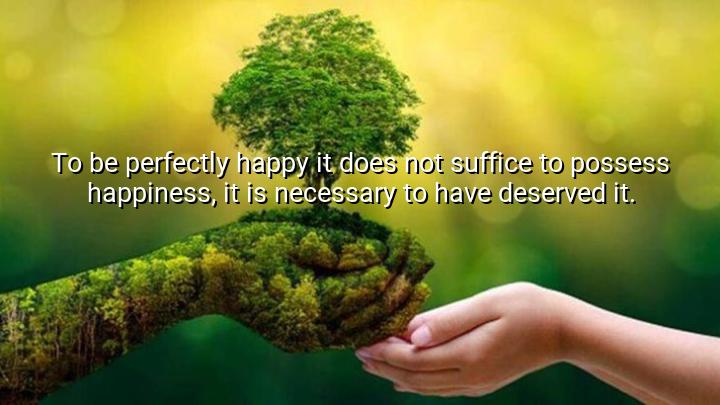




The quote by Victor Hugo — "To be perfectly happy it does not suffice to possess happiness, it is necessary to have deserved it" — suggests that true happiness goes beyond simply experiencing joy or contentment. Hugo argues that in order to feel fully satisfied and at peace, one must feel that their happiness is earned or the result of virtuous actions. It is not enough to passively receive happiness; one must deserve it by living in a way that aligns with one's values, actions, and ethical principles.
Hugo's perspective reflects a deeper philosophical view of happiness as not just a fleeting emotion but a sense of fulfillment that comes from living a meaningful and morally sound life. According to this idea, happiness is connected to the notion of personal integrity and moral righteousness. If a person feels that their happiness is the result of their own good deeds, hard work, or kindness, it becomes more profound and fulfilling.
This quote can also be seen as a critique of superficial or materialistic understandings of happiness, where one might achieve pleasure or success without having worked for it or earned it through good character. For Hugo, happiness that is not earned lacks depth and is less likely to bring true inner peace. His words suggest that personal growth and virtue are essential components of a truly satisfying life.
In essence, Hugo’s quote emphasizes that happiness is not just about experiencing joy, but about feeling worthy of it. Deserving happiness through virtuous actions, kindness, and moral integrity provides a deeper, more lasting sense of fulfillment. Hugo encourages us to strive for goodness and virtue, which will, in turn, lead to a more authentic and lasting happiness.

AAdministratorAdministrator
Welcome, honored guests. Please leave a comment, we will respond soon