

To attempt to superimpose its views through the exercise of force, is seldom the part of intelligence; it is frequently the part of ignorance.
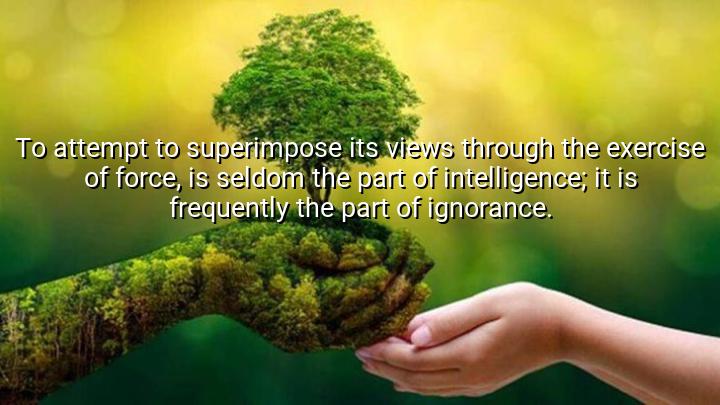




The quote "To attempt to superimpose its views through the exercise of force, is seldom the part of intelligence; it is frequently the part of ignorance" by Paul P. Harris emphasizes the idea that using force to impose one's beliefs or opinions on others is not a sign of intelligence or wisdom, but rather a reflection of ignorance. Harris suggests that true intellectual strength lies in persuasion, dialogue, and understanding, rather than in coercion or violence. He points out that when one resorts to force to push their agenda, it reveals a lack of respect for others' perspectives and an inability to engage in thoughtful discussion or find common ground.
Harris's quote critiques the common tendency of some individuals, groups, or even nations, to use power to dominate others instead of seeking peaceful and intelligent solutions. By labeling the use of force as a characteristic of ignorance, he implies that a truly intelligent society should foster open communication, empathy, and mutual respect, rather than relying on brute strength to control or manipulate. In this context, intelligence involves understanding and considering the needs, rights, and voices of others.
The origin of this quote can be traced back to Paul P. Harris, the founder of Rotary International, a global organization focused on service, peace, and humanitarian work. Harris was a strong advocate for dialogue, collaboration, and community building, believing that true progress comes from mutual understanding and cooperation, not through imposition or force. His work in Rotary reflected these ideals, and this quote embodies his commitment to promoting peace and intellectual exchange over conflict.
Ultimately, Harris’s quote reminds us that intelligence is not about dominating others but about engaging in thoughtful, constructive conversations and seeking solutions that respect diverse perspectives. It serves as a call to move away from the impulse to use force in favor of understanding and collaboration, suggesting that the path to true wisdom is one of patience, dialogue, and mutual respect.

AAdministratorAdministrator
Welcome, honored guests. Please leave a comment, we will respond soon