

Those who have knowledge, don't predict. Those who predict, don't have knowledge.
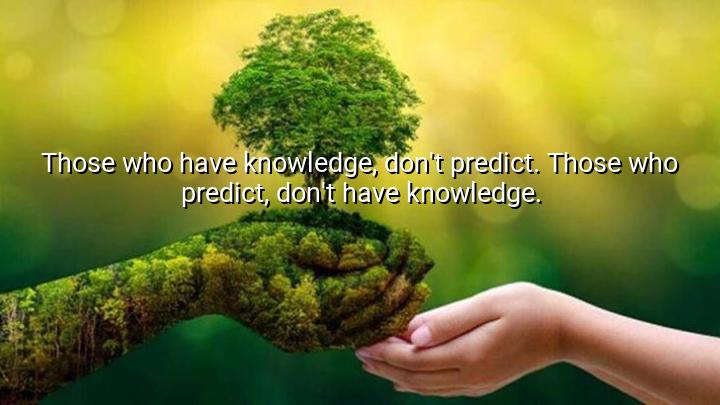




The quote "Those who have knowledge, don't predict. Those who predict, don't have knowledge" by Lao Tzu emphasizes the difference between true wisdom and the act of predicting the future. Lao Tzu, a foundational figure in Taoism, suggests that those who possess true knowledge or deep understanding do not feel the need to make speculative predictions about the future. Instead, they remain grounded in the present, understanding that true wisdom comes from living in harmony with the flow of life rather than trying to control or predict its outcomes.
The quote implies that predicting the future is an act of uncertainty, driven by assumptions or incomplete information. By contrast, knowledge is rooted in a deep understanding of the present moment and the ability to perceive and adapt to life’s natural rhythms. Those who claim to predict the future are often relying on speculation rather than true knowledge, which can lead to uncertainty and misguidance.
Lao Tzu’s teachings, found in the Tao Te Ching, often center around the idea of acceptance and living in accordance with the natural order of the universe, or the Tao. He believed that true wisdom comes from simplicity and stillness, and that those who possess deep knowledge understand that the future is unpredictable and should be left to unfold naturally.
Ultimately, this quote invites us to reflect on the nature of knowledge and prediction. Lao Tzu’s perspective encourages humility, urging us to acknowledge that we cannot control or foresee everything. True wisdom, according to Lao Tzu, lies not in making predictions, but in accepting the uncertainty of life and aligning with its natural flow.

AAdministratorAdministrator
Welcome, honored guests. Please leave a comment, we will respond soon