

This man is freed from servile bands, Of hope to rise, or fear to fall; Lord of himself, though not of lands, And leaving nothing, yet hath all.
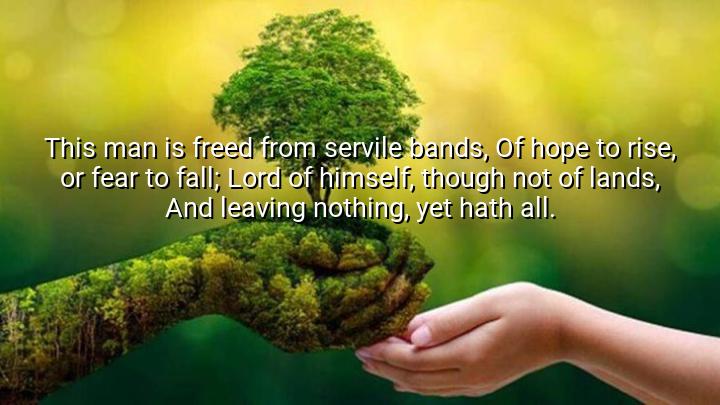




The quote "This man is freed from servile bands, Of hope to rise, or fear to fall; Lord of himself, though not of lands, And leaving nothing, yet hath all" by Lord Byron reflects a powerful expression of personal freedom and self-mastery. Byron, a prominent British poet and leading figure in the Romantic movement, often explored themes of individualism, liberation, and the complexities of the human spirit. In this quote, he describes a person who, though lacking material wealth or external power, has achieved a higher form of freedom by being in control of their own destiny and actions.
The origin of this quote lies in Byron’s fascination with the individual and the pursuit of autonomy. By stating that the man is "freed from servile bands," Byron suggests that true freedom comes not from social status or land ownership, but from the ability to transcend external pressures and live according to one's own principles. The line "Lord of himself, though not of lands" emphasizes that self-mastery and inner strength are more valuable than external power or wealth.
In this context, Byron contrasts hope and fear—two forces that often govern human behavior. The man described in the quote is free from the need to rise or fear the consequences of falling, indicating a state of emotional and spiritual equilibrium. This implies that true freedom is found not in the pursuit of wealth or success, but in the ability to remain unshaken by the uncertainties of life. Inner peace and self-determination are the ultimate forms of wealth.
Ultimately, Byron’s quote suggests that a person who has achieved self-control and independence has all they truly need, regardless of their material circumstances. It celebrates the idea that true fulfillment comes from personal growth and the freedom to make choices based on one’s values, rather than being driven by external expectations or fears. The man who "leaves nothing, yet hath all" is a symbol of spiritual richness, illustrating that internal freedom surpasses the pursuit of material wealth or status.

AAdministratorAdministrator
Welcome, honored guests. Please leave a comment, we will respond soon