

This is the artist, then, life's hungry man, the glutton of eternity, beauty's miser, glory's slave.
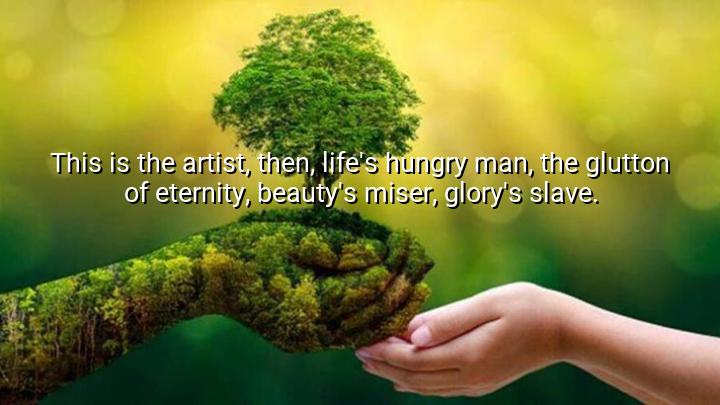




Tom Wolfe’s quote, “This is the artist, then, life’s hungry man, the glutton of eternity, beauty’s miser, glory’s slave,” presents a complex and somewhat critical view of the artist's role in society. Wolfe characterizes the artist as someone who is insatiably hungry, constantly seeking beauty and glory, yet never truly satisfied. The artist's desire for expression, recognition, and eternal significance is portrayed as a constant craving—an obsession that defines their existence. The terms glutton and miser suggest a paradox: while the artist consumes everything around them in their search for beauty, they also hoard it, endlessly seeking and never finding fulfillment.
Wolfe's use of “life's hungry man” emphasizes the artist's deep and relentless need for experience and inspiration. The artist is described as always pursuing something—whether it be beauty, meaning, or glory—but never quite reaching a satisfying conclusion. By calling the artist a glutton of eternity, Wolfe alludes to the artist's desire for something beyond the temporal world, as if they are striving to capture something eternal through their work. This pursuit, however, often remains elusive, leaving them hungry and unsatisfied.
In calling the artist “beauty’s miser,” Wolfe touches on the artist’s paradoxical relationship with beauty. While artists are often seen as creators of beauty, they are simultaneously obsessed with it, constantly seeking more and never fully content with what they create or experience. The phrase “glory’s slave” suggests that the artist is not only driven by beauty but also by the desire for recognition and fame, placing them at the mercy of external validation and the ever-changing tastes of society.
The origin of this quote can be traced to Wolfe’s broader exploration of the art world and the personalities that shape it. As a journalist and writer, Wolfe often critiqued various aspects of society, including the art world. His portrayal of the artist in this quote reflects his view that the artist’s pursuit of beauty and glory can be both a blessing and a curse—a lifelong hunger that can never be fully satisfied. Wolfe’s works often tackled themes of excess, obsession, and the contradictions inherent in human desires, and this quote is a reflection of that worldview.

AAdministratorAdministrator
Welcome, honored guests. Please leave a comment, we will respond soon