

This idea of 'cool capitalism' is still capitalism. It doesn't matter if Elon Musk quotes Nas.
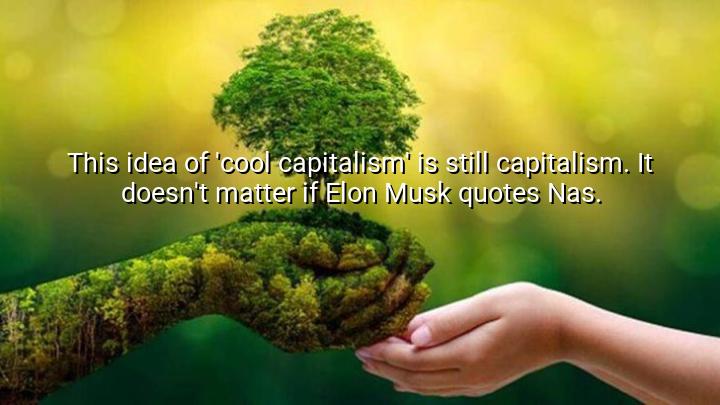




In this quote, Boots Riley, an American activist and musician, critiques the concept of "cool capitalism" and how it perpetuates the same inherent issues as traditional capitalism. Riley argues that despite attempts to make capitalism appear more appealing or socially aware—such as when Elon Musk references popular culture figures like rapper Nas—it doesn't change the fundamental dynamics of the system. Riley's point is that the surface-level coolness or cultural references don't address the underlying problems of capitalism, such as inequality and exploitation.
Riley's statement challenges the idea that embracing popular culture or adopting a more relatable, "hip" image can make capitalism any less exploitative. By mentioning Musk’s use of Nas's music, he highlights how even influential figures in the capitalist system may try to appear more progressive or inclusive, but their actions still operate within the confines of a profit-driven system. This critique is rooted in Riley's broader political views, which emphasize the need to question and address systemic issues rather than simply decorating or marketing them as more palatable.
The quote also critiques how capitalist systems often use cultural integration or associations with art and entertainment to mask the negative effects of their operations. In this case, Riley suggests that people may feel more comfortable with capitalist figures who seem more aligned with their interests or tastes, but it doesn’t change the fact that capitalism still creates inequalities and perpetuates harm to marginalized communities.
Ultimately, Riley’s comment serves as a reminder to critically examine the true nature of capitalism and not be distracted by superficial attempts to make it more "cool" or acceptable. His words encourage a deeper investigation into the economic systems that shape society, urging people to recognize that simply adding cultural elements or references doesn't address the core issues of inequality and exploitation that persist within capitalism.

AAdministratorAdministrator
Welcome, honored guests. Please leave a comment, we will respond soon