

There's no question that as science, knowledge and technology advance, that we will attempt to do more significant things. And there's no question that we will always have to temper those things with ethics.
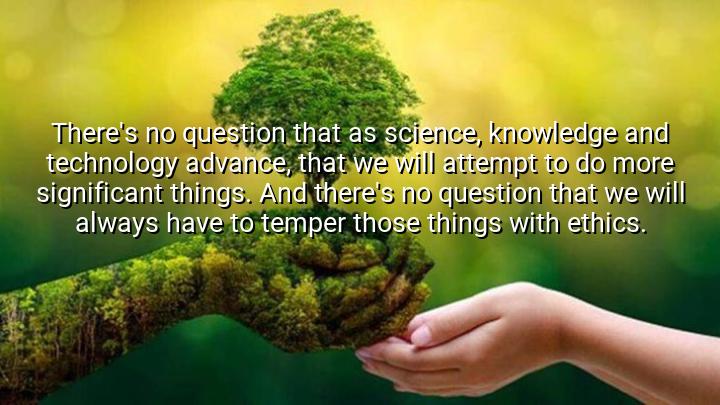




The quote “There's no question that as science, knowledge and technology advance, that we will attempt to do more significant things. And there's no question that we will always have to temper those things with ethics.” is attributed to Ben Carson, the American neurosurgeon, author, and political figure. At its core, the statement highlights the dual nature of scientific and technological advancement—that while progress enables humanity to accomplish greater achievements, it also raises profound ethical challenges that must be carefully considered.
The origin of this idea can be tied to Carson’s medical career, particularly as a pioneering neurosurgeon. His groundbreaking work in surgeries, such as separating conjoined twins, was made possible by advances in medical science and technology. However, he often spoke about the importance of balancing these innovations with moral responsibility. His words reflect the longstanding debate in medicine and science: just because something can be done does not always mean it should be done.
The meaning of the quote emphasizes the need for ethics to guide human progress. As knowledge expands, new possibilities emerge in fields like genetics, artificial intelligence, and biotechnology. Without ethical principles, these advancements risk being misused, potentially harming individuals or society. Carson reminds us that progress must always serve humanity’s best interests rather than simply pursue power or curiosity unchecked.
Ultimately, Carson’s statement serves as both a recognition of human potential and a cautionary note. He acknowledges that the pursuit of science and technology will never stop, but insists that it must be accompanied by wisdom and moral integrity. By placing ethics at the center of progress, his words call for a balance between innovation and responsibility, ensuring that advancement truly benefits humanity.

AAdministratorAdministrator
Welcome, honored guests. Please leave a comment, we will respond soon