

There's no better example of how to lead a difficult employee than to have a child. You have another kind of knowledge from your children that's actually applicable outside of childbearing.
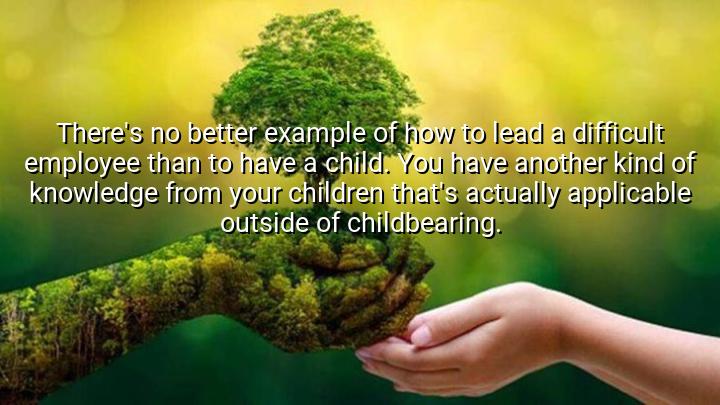




The quote “There’s no better example of how to lead a difficult employee than to have a child. You have another kind of knowledge from your children that’s actually applicable outside of childbearing.” by Alissa Quart draws a parallel between parenting and leadership. Quart suggests that raising a child equips parents with unique knowledge and practical skills—such as patience, negotiation, empathy, and problem-solving—that can be applied in professional settings, particularly in managing difficult employees. Her words highlight how personal experiences can enrich one’s approach to leadership and workplace dynamics.
The origin of this statement comes from Quart’s broader work as a journalist, cultural critic, and author who often explores the intersections of family life, work, and social expectations. In her writings, she frequently discusses how roles traditionally seen as “domestic,” such as childbearing and parenting, provide valuable insights and transferable skills. By framing child-rearing as a form of leadership training, Quart challenges the undervaluation of caregiving in both cultural and professional contexts.
The meaning of the quote is that parenting develops forms of knowledge that extend beyond the home. Dealing with the challenges of raising children—who can be demanding, unpredictable, or resistant—trains individuals in the same leadership skills required to manage employees effectively. Quart emphasizes that the competencies gained in nurturing and guiding children are not separate from professional life but deeply applicable to leadership roles in the workplace.
Ultimately, Quart’s words elevate the value of caregiving as a form of preparation for broader societal and organizational responsibilities. By linking parenting with leadership, she critiques the tendency to separate family life from professional expertise. Her insight affirms that lessons learned from raising children contribute to building more empathetic, adaptive, and effective leaders.

AAdministratorAdministrator
Welcome, honored guests. Please leave a comment, we will respond soon