

There's a snobbery at work in architecture. The subject is too often treated as a fine art, delicately wrapped in mumbo-jumbo. In reality, it's an all-embracing discipline taking in science, art, maths, engineering, climate, nature, politics, economics.
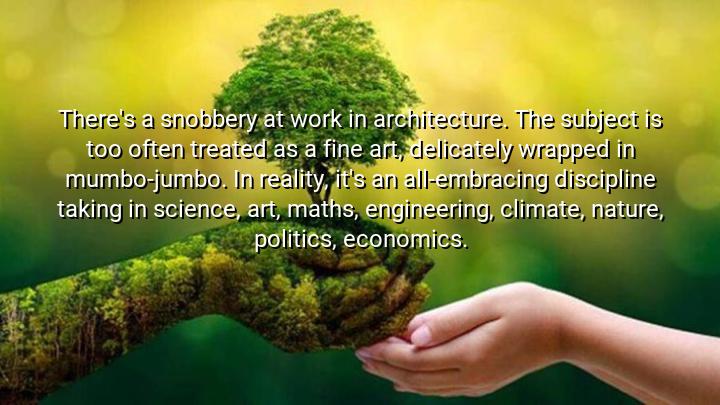




Norman Foster’s quote, “There's a snobbery at work in architecture. The subject is too often treated as a fine art, delicately wrapped in mumbo-jumbo. In reality, it's an all-embracing discipline taking in science, art, maths, engineering, climate, nature, politics, economics,” is a powerful critique of how architecture is sometimes misrepresented or mystified. Foster points out that while architecture is often praised for its aesthetic qualities, it is far more than just a visual or cultural expression—it is a complex, interdisciplinary practice grounded in both creativity and technical expertise.
The origin of this quote lies in Foster’s long-standing commitment to rational design, sustainability, and technological innovation. As one of the most influential architects of the modern era, responsible for projects like The Gherkin in London and Apple Park in California, Foster has consistently advocated for a more transparent, functional, and holistic approach to architecture. His frustration with the “mumbo-jumbo” refers to the overly theoretical or elitist language that can alienate the public and obscure the real-world impact of architectural design.
By emphasizing the integration of science, engineering, climate, and politics, Foster reminds us that architecture is fundamentally about problem-solving within the built environment. It requires knowledge of materials, energy efficiency, social needs, and economic feasibility—not just artistic vision. This broad scope means that architects must operate across multiple domains, collaborating with various professionals and engaging with practical realities as much as with design ideals.
Ultimately, Foster’s quote is a call for demystifying architecture and recognizing its role as a public-serving discipline. He challenges the notion that architecture belongs only to the cultural elite and urges a more inclusive, rigorous, and accessible understanding of its purpose. By grounding architecture in the real and measurable, Foster believes it can better contribute to human progress, sustainability, and urban wellbeing.

AAdministratorAdministrator
Welcome, honored guests. Please leave a comment, we will respond soon