

There must be something solemn, serious, and tender about any attitude which we denominate religious. If glad, it must not grin or snicker; if sad, it must not scream or curse.
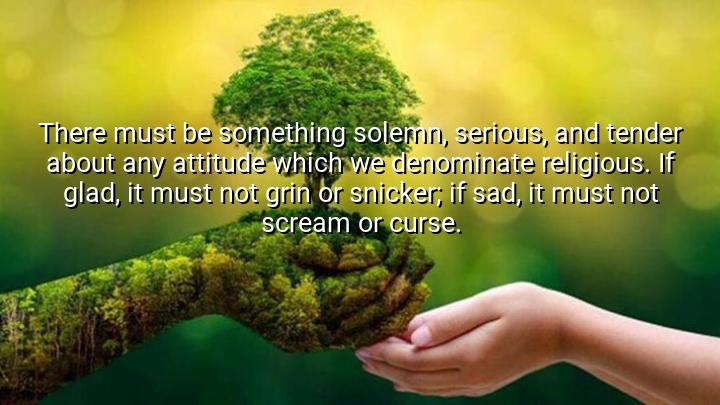




The quote by William James, "There must be something solemn, serious, and tender about any attitude which we denominate religious. If glad, it must not grin or snicker; if sad, it must not scream or curse," explores the nature and tone of what defines a truly religious attitude. James emphasizes that religious feelings carry a sense of reverence and depth, regardless of whether they are expressions of joy or sorrow. This solemnity ensures that religious experiences are marked by respect and dignity, avoiding trivial or disrespectful expressions such as grinning, snickering, screaming, or cursing.
The origin of this quote is from William James, a pioneering American philosopher and psychologist who extensively studied religion and human consciousness. He sought to understand the psychology of religious experience and believed that a religious attitude is fundamentally about a profound, sincere connection with the sacred or the divine. The quote reflects his belief that religion involves more than belief; it requires a certain seriousness and emotional control that respects the mystery and gravity of spiritual life.
This quote highlights the balance between emotional expression and restraint within religious practice. James acknowledges that religious emotions can be strong, whether joyful or sorrowful, but insists they maintain a tone of tenderness and solemnity. This approach fosters an environment where spirituality is honored with the respect it deserves, allowing it to be deeply meaningful and transformative.
In summary, William James’s quote defines the religious attitude as one of solemn respect and emotional restraint, reflecting the seriousness and tenderness that give religion its unique character. It encourages us to approach spirituality with a sense of dignity that honors both the joy and the sorrow inherent in the human experience.

AAdministratorAdministrator
Welcome, honored guests. Please leave a comment, we will respond soon