

There may be a great fire in our hearts, yet no one ever comes to warm himself at it, and the passers-by see only a wisp of smoke.
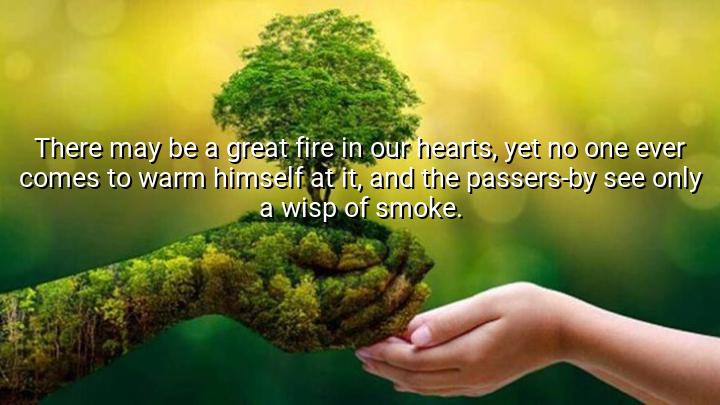




The quote "There may be a great fire in our hearts, yet no one ever comes to warm himself at it, and the passers-by see only a wisp of smoke" by Vincent Van Gogh reflects the internal emotional conflict between having profound passion or creativity and feeling unseen or unappreciated by others. Van Gogh suggests that despite the great fire—representing intense feelings, creativity, or potential—that burns within us, it may not be recognized or valued by those around us. Instead, what others may perceive is only the wisp of smoke, a faint trace of our inner world, not fully understood or acknowledged.
Van Gogh's words may reflect his personal struggles as an artist. Despite his immense creativity and the powerful emotional depth in his work, he often faced isolation and was not widely appreciated during his lifetime. This quote encapsulates the feeling of having much to offer but being overlooked, as well as the frustration of knowing that others can’t see the full extent of your inner world. The fire symbolizes the deep, burning passion or talent, while the smoke represents the limited, superficial recognition that might be given to it.
The idea of a great inner fire being unnoticed by others also touches on the broader theme of unfulfilled potential. Many individuals feel that their true selves, talents, or feelings go unnoticed or underappreciated by society. The quote speaks to the emotional isolation that often accompanies this experience, as others fail to recognize the depth of what lies within. For Van Gogh, this might have been an expression of his own sense of alienation from the world and his struggle to be understood.
In essence, Van Gogh's quote highlights the emotional tension between self-expression and public recognition. It suggests that even though we may harbor immense passion, creativity, or potential, the world may only see the surface, missing the true essence of who we are or what we can offer. The fire may burn brightly within us, but for various reasons, it remains unseen, leaving us with only the smoke to show for it.

AAdministratorAdministrator
Welcome, honored guests. Please leave a comment, we will respond soon