

There is no kind of dishonesty into which otherwise good people more easily and frequently fall than that of defrauding the government.
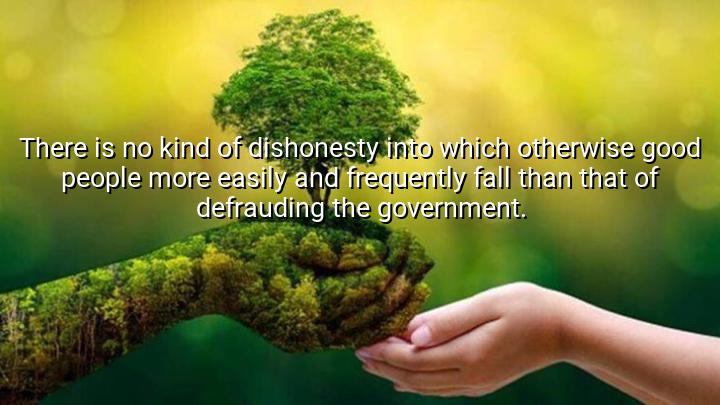




The quote by Benjamin Franklin addresses the temptation of dishonesty in relation to government. Franklin suggests that even good people, who would not normally engage in unethical behavior, are often quick to fall into the trap of defrauding the government. This could involve actions like evading taxes, taking advantage of loopholes, or engaging in other forms of financial dishonesty. Franklin points out that such actions are a form of dishonesty that is particularly easy to justify and commit, even for those with otherwise good moral character.
Franklin's words reflect his understanding of human nature and the tendency to rationalize actions when they involve larger institutions, like the government. The idea that people may feel less guilty about defrauding a faceless institution as opposed to an individual plays into the broader theme of how people justify unethical behavior when they feel the government is not personally affected. Franklin is emphasizing that personal morality should not be compromised just because the entity being defrauded is the state.
The origin of this quote lies in Franklin's broader reflections on society, morality, and governance. As one of the Founding Fathers and an influential thinker, Franklin often wrote about the principles that should guide the new American government and its relationship with citizens. His work, particularly in his autobiography and letters, shows his concern about the ethical responsibilities of both individuals and governments in maintaining a just and functional society.
Ultimately, Franklin’s words serve as a reminder that integrity should be upheld even when dealing with larger systems like the government. Dishonesty—even in seemingly harmless forms—undermines the moral fabric of society and can lead to corruption and inefficiency within governmental systems. Franklin’s insight is timeless, urging people to act with honesty and fairness, regardless of the context or the size of the entity they are dealing with.

AAdministratorAdministrator
Welcome, honored guests. Please leave a comment, we will respond soon