

There is a lot of bad architecture. What we need more is to look at how our landscape should look in the next decades.
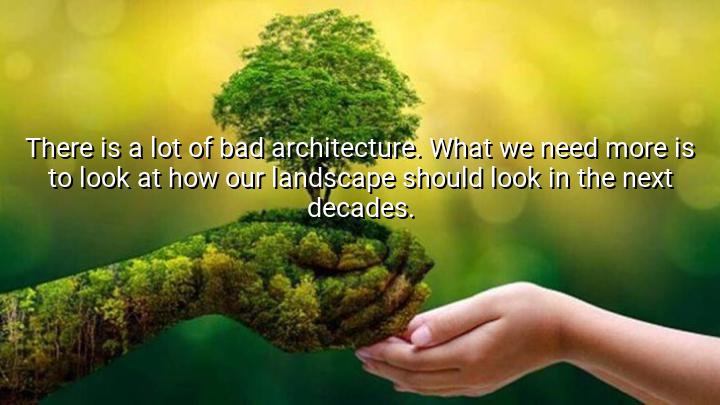




The quote by Dieter Rams, "There is a lot of bad architecture. What we need more is to look at how our landscape should look in the next decades," is a critique of careless or short-sighted architectural practices, and a call for more forward-thinking and sustainable design. Rams, a legendary German industrial designer known for his “Less, but better” philosophy, applies the same principles of clarity, function, and responsibility to the built environment. His statement reflects concern for how architecture is shaping our urban and natural landscapes, often without enough consideration for the future.
By acknowledging the presence of “a lot of bad architecture,” Rams highlights the prevalence of buildings that may be aesthetically poor, inefficient, or out of harmony with their surroundings. These structures often prioritize short-term gains—such as cost-cutting or trend-following—over long-term value, functionality, or environmental impact. His solution isn’t simply about improving style or taste, but about rethinking our design priorities to align with sustainable development and civic well-being.
Rams urges architects, planners, and designers to shift their focus toward the future of the landscape—to imagine what our cities, towns, and environments should look like decades from now, not just tomorrow. This includes considering climate change, urban density, resource use, and the emotional quality of public spaces. His perspective encourages a holistic approach to architecture that balances aesthetics, ethics, and ecology.
Ultimately, Rams' quote is a reminder that design has consequences—and that architecture, as one of the most visible and permanent forms of design, must take responsibility for shaping the future environment. His words invite us to reject mediocrity and embrace visionary thinking, where buildings contribute not only to present needs but to a more livable, thoughtful, and beautiful world in the years to come.

HTMai Hoang Thi
Reading this quote, I can’t help but think about how often we view architecture as isolated rather than part of a bigger visual and ecological landscape. Rams seems to be urging us to look beyond buildings and consider the full tapestry of our surroundings. What would it take to develop architectural standards that prioritize environmental integration and future adaptability over flashy, short-lived statements?
MTdang ha mai trang
I’m struck by the simplicity and urgency of Rams’ message. He's not just criticizing—he’s encouraging a change in mindset. But I wonder, how realistic is it to expect architects to prioritize decades-long thinking when most clients want quick, budget-conscious results? Is this a failure of architectural culture, or of the economic systems surrounding it? How do we make future-conscious design both viable and desirable in today’s world?
KVTran Khanh Vy
This quote immediately made me think about the sheer volume of disposable or contextless architecture that fills our urban spaces. Is Rams pointing at the effects of profit-driven design? If so, how do we shift the incentive structure so that long-term planning becomes the default, not the exception? It feels like developers, policymakers, and architects need a shared framework for imagining and building toward a collective future.
TLNguyen Thi Thuy Linh
I really appreciate how this quote ties aesthetics to responsibility. It’s easy to get caught up in trends, but Rams reminds us that design choices shape the environments people live in every day. Should architects be trained more like urban futurists, considering climate, demographics, and even politics in their work? It makes me think that maybe architecture schools should integrate long-range forecasting into their core curricula.
TTtoan trinh
Rams’ statement is powerful, but also a bit daunting. Who gets to decide what the future landscape should look like? Architects? Governments? Communities? The idea is inspiring, but it also raises concerns about inclusivity and cultural representation. How do we ensure that the long-term vision he’s advocating for isn’t shaped by just a narrow segment of society, but truly reflects diverse voices and values?