

There are pretenders to piety as well as to courage.
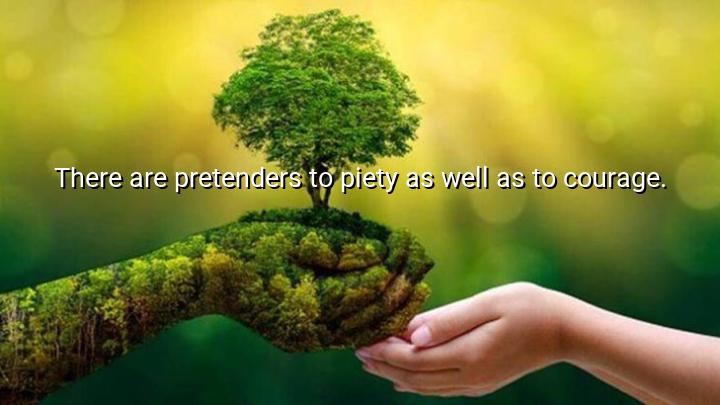




In this quote, Molière points out that just as there are people who pretend to be courageous, there are also individuals who feign being pious. The idea behind the statement is that some people may outwardly display virtues such as bravery or religious devotion, but their actions or inner character may not align with these portrayals. These individuals put on a mask of righteousness or bravery to gain respect or admiration from others, but their true nature might be very different.
Molière's statement speaks to the concept of hypocrisy and how individuals sometimes try to deceive others by putting on a facade of piety or courage. This pretense can be seen as a form of self-interest, where people aim to receive social approval or admiration by appearing virtuous, even though their motives may be less than noble. Molière warns that external appearances do not always reflect the true nature of a person’s character.
This quote is rooted in the moral commentary that Molière often incorporated into his plays, especially in his satire of the French aristocracy and the societal norms of his time. He was deeply concerned with the way hypocrisy often went unnoticed or unchallenged, especially when it came to the performance of virtue. In many of his works, characters who feign piety or bravery are eventually exposed for their lack of authenticity, revealing the dangers of superficial appearances.
Molière, a French playwright known for his keen insights into human nature, used this quote to highlight the deceptive tendencies of individuals and society. It serves as a reminder to look beyond the surface and to recognize that true virtue lies in one's actions and character, not in how one presents themselves to others.

AAdministratorAdministrator
Welcome, honored guests. Please leave a comment, we will respond soon