

There are many deaf people who couldn't imagine living in a marriage without someone who doesn't speak their language. For me, I believe that hearing or deaf is fine as long as both parties are willing to communicate in each other's language. But if there's no communication, then the marriage, I believe, will be difficult if not doomed.
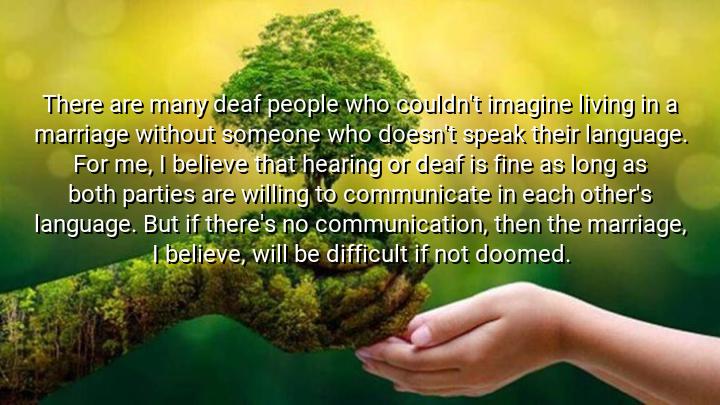




Marlee Matlin’s quote emphasizes the critical role of communication in any relationship, especially within a marriage. She acknowledges that for many deaf people, it can be difficult to imagine living in a marriage where both partners do not share the same language. Matlin reflects on the idea that whether one partner is hearing or deaf, the key to a successful marriage is the willingness of both individuals to communicate in each other’s language, whether that’s spoken language, sign language, or another method of communication. Without communication, she suggests, the relationship faces significant challenges, potentially leading to its failure.
The origin of this quote comes from Matlin's personal experience as a deaf actress and advocate. As the first deaf performer to win an Academy Award, Matlin has spent much of her life navigating the intersections of deafness and mainstream society. She has often spoken about the importance of accepting diversity in communication methods, both personally and within relationships. Her quote reflects her belief in the power of understanding and the flexibility required to maintain connection, whether through verbal or nonverbal means.
Matlin’s statement also touches on the universal truth that communication is the foundation of any successful relationship. She stresses that while physical hearing or speech differences might exist, the real barrier in a marriage comes when communication breaks down. The absence of open, mutual communication—regardless of the medium—can lead to emotional distance, misunderstanding, and frustration.
Ultimately, Matlin’s quote underscores the idea that language—whether spoken, signed, or otherwise—is the lifeblood of any partnership. Her perspective encourages a willingness to adapt, listen, and engage in meaningful dialogue, suggesting that these principles are key to creating and sustaining strong relationships, no matter the challenges posed by differing abilities or communication styles.

AAdministratorAdministrator
Welcome, honored guests. Please leave a comment, we will respond soon