

There are a lot of people with a lot of money, and I'm amazed they don't understand what a great pleasure it can be to give.
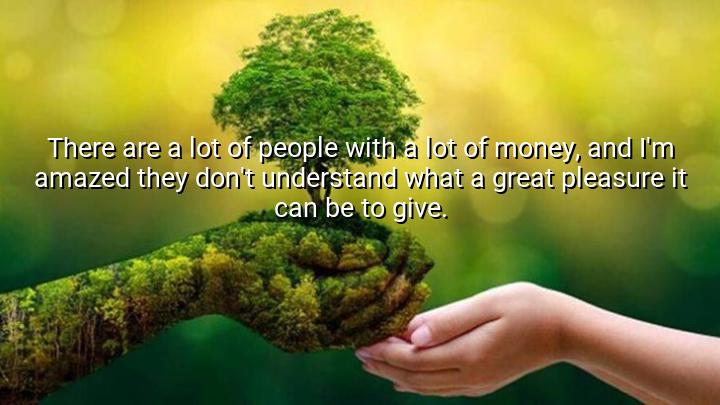




The quote by Robert Mondavi — "There are a lot of people with a lot of money, and I'm amazed they don't understand what a great pleasure it can be to give." — speaks to the concept of generosity and the fulfillment that comes from sharing one’s wealth. Mondavi, a renowned American wine maker, reflects on the idea that despite having significant financial resources, some individuals fail to realize the joy and satisfaction that can come from giving to others. His amazement stems from the fact that giving can be a deeply rewarding experience, both for the giver and the recipient.
Mondavi’s statement emphasizes that money is not just for personal enjoyment or accumulation, but it can also be a tool for creating positive change and fostering meaningful connections. The pleasure derived from giving — whether through charity, support, or gifts — can lead to a deeper sense of purpose and happiness, something that wealth alone cannot provide. Generosity is portrayed here not as a duty, but as an opportunity for enrichment that benefits both the person giving and the wider community.
The origin of this quote is tied to Mondavi’s own values as a businessman and philanthropist. Throughout his life, Mondavi was not only focused on building a successful wine empire but also on making a positive impact on his community and the wine industry. His experiences likely shaped his belief in the importance of giving as a means of experiencing fulfillment, rather than merely accumulating wealth.
Ultimately, Mondavi’s words remind us that true wealth lies not only in material possessions but in the ability to make a difference through generosity. The pleasure of giving is an opportunity that should be embraced by those who have the means to do so. By sharing what we have, we enrich our own lives while contributing to the well-being of others.

DTMy Dang Thao
This quote made me feel conflicted. On one hand, I agree that giving can bring immense joy. On the other, I wonder if the expectation that wealthy people *should* give adds unfair pressure. Should generosity come from genuine desire or social pressure? And if it’s the latter, does it lose some of its value? It raises important questions about the motivations behind philanthropy and the role of gratitude in giving.
TVNguyen Thi Van
I’m really curious—what do you think makes some wealthy people more generous than others? Is it upbringing, culture, religion, or just personality? Mondavi’s quote makes me wonder if empathy can be taught. Maybe people need to be shown how giving creates ripple effects in communities. Could storytelling or media help bridge this gap by making generosity feel more personal and urgent?
SAShoppe Acc
I find this quote refreshing and thought-provoking. It’s not about shaming the rich, but about highlighting what they’re missing emotionally. Giving doesn’t just help others—it enriches the giver’s life too. Maybe some people haven’t had a meaningful experience with giving, or maybe they’re too focused on financial gain to realize what they’re missing. Could early experiences with generosity play a role in shaping this mindset?
NHDo Ngoc Ha
This quote frustrates me a bit because it reflects something I’ve observed too—philanthropy isn’t always instinctual. Why do you think some wealthy individuals hoard resources instead of sharing them? Is it a lack of empathy, or have they been taught to see wealth as something to protect rather than something to use for good? It makes me wonder if wealth should come with a moral obligation to give back.
MTTrinh Thi Minh Thuy
I agree with the sentiment here. It’s baffling that immense wealth often coincides with a reluctance to give. Do you think this is more about a mindset of scarcity, even when abundance exists? Or could it be that some people view wealth as a measure of success, and giving feels like reducing that symbol? I’d love to hear examples where giving transformed not just the recipient, but also the giver.