

The war and terrorism in the Middle East, the crisis of leadership in many of the oil-supply countries in the developing world, the crisis of global warming - all these are very clearly tied to energy.
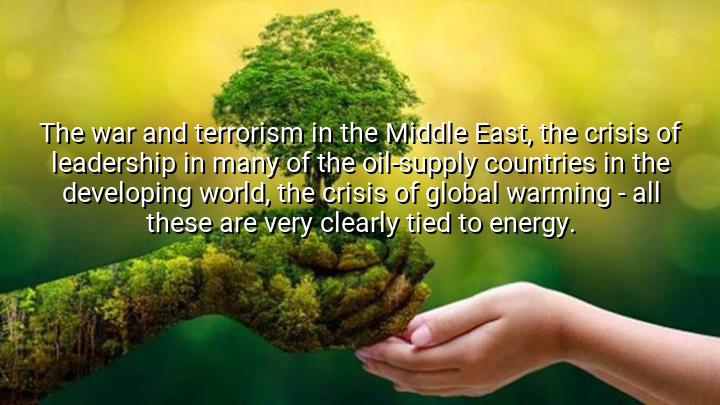




The quote “The war and terrorism in the Middle East, the crisis of leadership in many of the oil-supply countries in the developing world, the crisis of global warming – all these are very clearly tied to energy.” by Julia Louis-Dreyfus draws attention to the central role of energy in shaping some of the world’s most urgent challenges. She links war and terrorism, political leadership crises, and global warming to humanity’s reliance on and mismanagement of energy resources, particularly oil. Her words underscore the interconnectedness of political instability, environmental threats, and energy dependency.
The origin of this statement reflects Louis-Dreyfus’s involvement in environmental advocacy alongside her career as an actress. Best known for her comedic roles in shows like Seinfeld and Veep, she has also been an outspoken supporter of environmental organizations such as the Natural Resources Defense Council (NRDC). In this context, her quote highlights how her environmental concerns extend beyond climate change to include geopolitical and social issues linked to energy dependence.
The meaning of the quote is that many global crises share a common root: the world’s dependence on fossil fuels. In the Middle East, conflicts are often tied to struggles over control of oil resources. In developing countries, weak or corrupt leadership can be exacerbated by the wealth and political leverage derived from energy exports. Meanwhile, the burning of fossil fuels contributes directly to global warming, creating an environmental crisis with worldwide consequences. By naming these diverse issues together, Louis-Dreyfus emphasizes how energy sits at the heart of modern conflict and instability.
Ultimately, Louis-Dreyfus’s statement is a call to recognize energy not just as a commodity but as a defining factor in global security, governance, and sustainability. Her words align with broader environmental movements that argue for reducing dependence on fossil fuels and transitioning to renewable energy. By connecting terrorism, leadership crises, and climate change to the same root cause, she highlights the urgency of addressing energy policy as a cornerstone of solving multiple global challenges.

AAdministratorAdministrator
Welcome, honored guests. Please leave a comment, we will respond soon