

The universal Mind contains all knowledge. It is the potential ultimate of all things. To it, all things are possible.
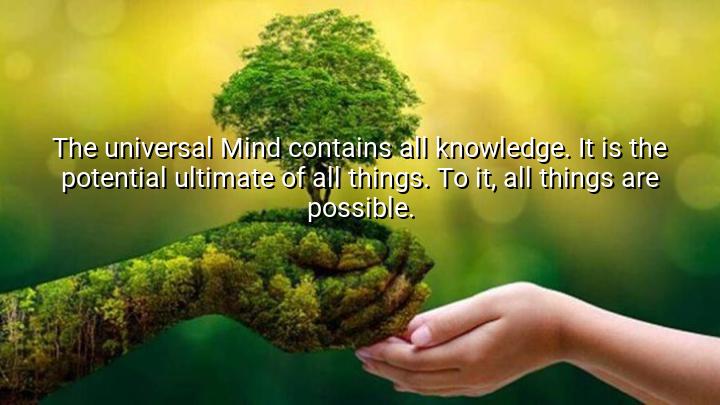




The quote by Ernest Holmes reflects his philosophy of spirituality and metaphysics, emphasizing the concept of a universal Mind. Holmes suggests that this Mind encompasses all knowledge and serves as the source of infinite potential. In this view, everything that exists or could exist originates from this universal consciousness, making all possibilities accessible through connection with it.
By stating that all things are possible to the universal Mind, Holmes emphasizes the limitless nature of creative and intellectual potential. Human beings, as expressions of this Mind, have the capacity to tap into its wisdom, insight, and power. This perspective encourages individuals to recognize their inherent connection to a greater source of knowledge and potential.
The quote also implies that understanding and alignment with the universal Mind can expand one’s awareness and capabilities. By acknowledging that the Mind contains all knowledge, Holmes advocates for a worldview in which learning, growth, and manifestation are rooted in spiritual awareness as much as in material effort or study.
Originating from Ernest Holmes, the founder of the Religious Science movement and a prominent New Thought teacher, the quote embodies his belief in the metaphysical principles that govern reality. Holmes’ philosophy emphasizes that the universal Mind is both a source of infinite knowledge and a guide for realizing human potential, making spiritual understanding a pathway to personal and collective transformation.

AAdministratorAdministrator
Welcome, honored guests. Please leave a comment, we will respond soon