

The ultimate goal of the architect...is to create a paradise. Every house, every product of architecture... should be a fruit of our endeavour to build an earthly paradise for people.
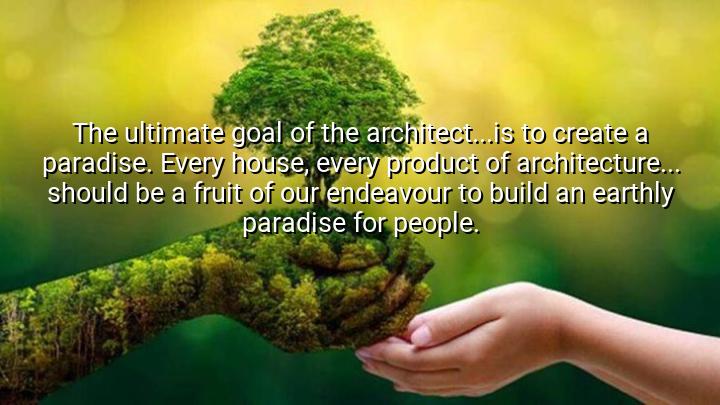




The quote by Alvar Aalto, "The ultimate goal of the architect...is to create a paradise..." reflects his deeply humanistic philosophy of architecture. Aalto believed that the purpose of design was not merely to provide shelter or solve technical problems, but to enhance human well-being and create spaces that felt like an earthly paradise. His vision of architecture was holistic—it had to nourish the senses, respect nature, and serve both emotional and practical needs.
As one of the most influential Finnish architects of the 20th century, Aalto was known for blending modernist principles with a warm, organic approach. His use of natural materials, soft forms, and human-scale design set him apart from more rigid strands of modernism. Buildings like the Villa Mairea or the Paimio Sanatorium exemplify this ideal, where light, texture, and space work together to create environments that are not only functional but uplifting and healing.
In saying that "every house, every product of architecture... should be a fruit of our endeavour," Aalto emphasizes the responsibility of the architect to improve the quality of life. He saw each project—whether a home, library, or chair—as an opportunity to make the world more beautiful, humane, and inspiring. His use of the word paradise is not about luxury or perfection, but about creating spaces that are deeply attuned to human needs, comfort, and joy.
Ultimately, this quote captures Aalto’s belief in architecture as a moral act—a means of bringing harmony between people and their surroundings. In striving to create a kind of paradise, architects are called not just to build, but to elevate life, turning everyday spaces into meaningful experiences. This ideal continues to inspire architects who see their work as a contribution to a better, more thoughtful world.

CPChou Pham
The use of the word 'paradise' here is powerful—it suggests harmony, beauty, peace. But is this goal compatible with urbanization, climate change, and population density? In cities filled with concrete and chaos, can architecture still aim for paradise? Or should the goal evolve into something more grounded—like resilience, sustainability, and inclusivity? Perhaps the new 'paradise' is less about aesthetics and more about survival with dignity.
NPNghiem Pham
This makes me think about the emotional and philosophical weight of architecture. If the goal is to create an earthly paradise, then architects are not just builders—they’re stewards of human well-being. That’s a huge responsibility. Do most architects even approach their work with that mindset? Or has the profession shifted too far toward commercialism and away from these deeper humanistic goals?
NMNguyen Nhat Minh
As a reader, I find this quote both inspiring and bittersweet. The idea that every home should be a small piece of paradise is lovely, especially when you consider how many people live in poorly designed or neglected spaces. It makes me question how design choices—big or small—impact people’s daily happiness. Could focusing on small improvements in comfort and beauty help bring us closer to this vision, even if perfection is unreachable?
D-13- Pham Tran An Duy -7A10
I love the ambition in this quote. It reminds me that architecture isn't just about structure—it’s about experience. But I also wonder if this level of idealism puts too much pressure on architects. Is it fair to expect them to build 'paradise' when so many systemic factors—urban planning, politics, economic inequality—are out of their control? It’s a beautiful vision, but maybe a bit overwhelming in its expectations.
VC10CT2-03- Phan Van Chanh
This quote made me think: what does 'paradise' even mean in a modern context? For some, it’s nature and light; for others, it’s safety, privacy, or community. Aalto seems to suggest that architecture should universally strive toward human joy and well-being, but isn’t that highly personal and subjective? Can an architect truly design something that feels like paradise to a broad and diverse population?