

The tree of knowledge is not the tree of life! And yet can we cast out of our spirits all the good or evil poured into them by so many learned generations? Ignorance cannot be learned.
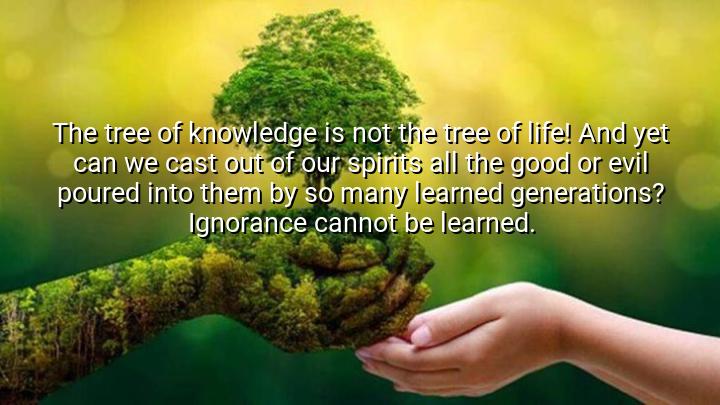




The quote by Gerard De Nerval contrasts knowledge and life, suggesting that the tree of knowledge is distinct from the tree of life. While acquiring knowledge can enlighten the mind, it does not inherently provide the vitality, meaning, or fulfillment associated with life itself. De Nerval implies that the pursuit of learning and intellectual accumulation is not a substitute for lived experience, moral growth, or spiritual richness.
By asking whether we can "cast out of our spirits all the good or evil poured into them by so many learned generations," De Nerval highlights the lasting impact of cultural, intellectual, and moral inheritance. Knowledge—whether used for good or evil—shapes the human spirit across generations. He reflects on the impossibility of escaping the influence of history, tradition, and accumulated wisdom or folly, emphasizing that education and ideas leave an indelible mark on our consciousness.
The statement "Ignorance cannot be learned" underscores a paradoxical insight: while knowledge can be acquired, ignorance is innate or persistent unless actively countered by learning. De Nerval seems to suggest that human beings are always in tension with inherited ideas, struggling to discern which knowledge to embrace and which preconceptions to discard. This evokes a deeper philosophical reflection on learning, wisdom, and the human condition.
Originating from Gerard De Nerval, a French poet and essayist of the 19th century, the quote reflects his interest in introspection, philosophy, and the interplay between the mind and inherited knowledge. De Nerval’s work often explored the limits of human understanding, the weight of tradition, and the quest for spiritual and intellectual clarity. In this context, the quote serves as a meditation on the enduring influence of knowledge, the challenge of navigating moral and intellectual inheritance, and the distinction between learning and the essence of life itself.

AAdministratorAdministrator
Welcome, honored guests. Please leave a comment, we will respond soon