

The thing that is really hard, and really amazing, is giving up on being perfect and beginning the work of becoming yourself.
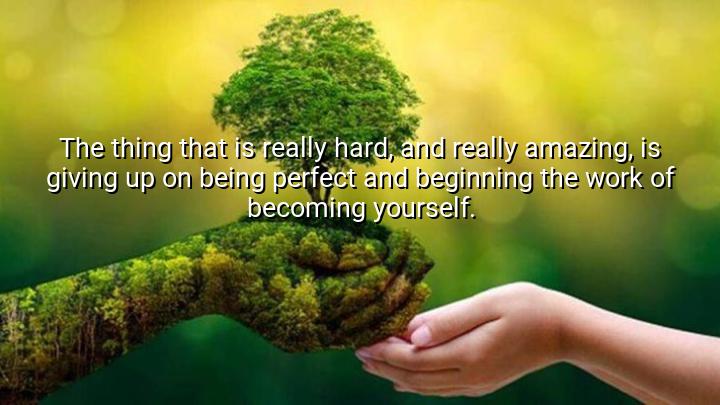




The quote by Anna Quindlen — "The thing that is really hard, and really amazing, is giving up on being perfect and beginning the work of becoming yourself." — highlights the challenge and significance of embracing imperfection and the journey of self-discovery. Quindlen suggests that striving for perfection can be a barrier to personal growth, as it often leads to self-imposed limitations and dissatisfaction. The truly amazing part of life comes when we let go of this unrealistic standard and start to focus on being our authentic selves.
Quindlen’s statement speaks to the common struggle of trying to meet external expectations and the societal pressure to be perfect. By acknowledging that perfection is neither achievable nor necessary, we are freed to focus on what makes us truly unique. This process of becoming yourself requires vulnerability, self-acceptance, and the courage to face our flaws, but it ultimately leads to a more fulfilling and genuine life.
The origin of the quote reflects Quindlen's writing, which often touches on themes of personal growth, identity, and the pressures of modern life. As an author and journalist, Quindlen has explored the importance of embracing one’s true self over conforming to external standards. Her work encourages readers to prioritize authenticity over perfection, which is a central message in many of her essays and books.
Ultimately, Quindlen’s quote serves as a reminder that true growth and fulfillment come from letting go of the need for perfection and focusing on the ongoing journey of self-improvement. It encourages individuals to accept their imperfections, embrace their uniqueness, and begin the transformative work of becoming who they truly are. The amazing aspect of this process lies in the freedom it brings and the deeper sense of purpose and satisfaction it offers.

HHHieu Hoang
This statement feels like a relief, but also a challenge. Letting go of perfection sounds liberating, but isn’t there a fear that people will judge the ‘real you’ more harshly than the polished version? I sometimes wonder if people truly value authenticity, or just say they do. How do you build the courage to be seen as imperfect—especially in environments where success often seems tied to image?
LKLong Kim
I love the honesty of this quote—it captures something really deep. But I keep asking myself: what does ‘becoming yourself’ even mean? It sounds poetic, but is there a clear way to know when you’re doing it? Does it mean following passions, accepting flaws, or something else entirely? I’d like to hear different interpretations because this feels like a question we all quietly wrestle with.
KTPham Nu Kieu Trinh
This quote really resonates with me, especially in today’s social media-driven world where perfection seems like a constant performance. But how do you balance the pressure to be 'liked' with the need to be true to yourself? I think a lot of people, especially younger ones, struggle with this duality. Is there a point where being your true self actually feels risky in a public or professional setting?
ANan nguyen
Does this mean that striving for self-improvement is different from striving for perfection? I’m trying to understand where the line is. Can you aim to grow without falling back into the trap of perfectionism? Sometimes I feel like the pressure to be your ‘best self’ is just perfectionism in disguise. How do you pursue who you really are without setting unrealistic expectations on what that version should look like?
GHPham Gia Huy
I find this quote incredibly moving, but I also wonder—how do you even start the process of letting go of perfectionism when it’s been part of your identity for so long? It’s easy to say, but it feels terrifying in practice. Is there a moment or experience that usually triggers that shift, or is it more of a gradual realization? I’d love to hear how others have approached this journey authentically.