

The theological virtue of hope is the patient and trustful willingness to live without closure, without resolution, and still be content and even happy because our Satisfaction is now at another level, and our Source is beyond ourselves.
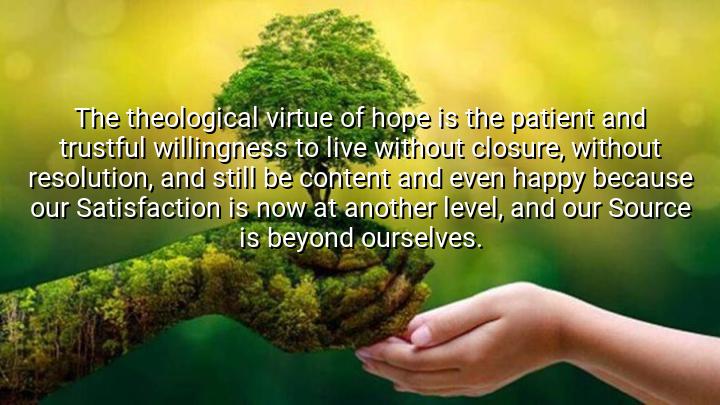




In the quote, "The theological virtue of hope is the patient and trustful willingness to live without closure, without resolution, and still be content and even happy because our Satisfaction is now at another level, and our Source is beyond ourselves," Richard Rohr, a Franciscan friar and spiritual writer, is exploring the deeper nature of hope from a spiritual and theological perspective. Rohr describes hope as a virtue that requires patience and trust, especially when we are unable to find immediate answers or closure in our lives. He suggests that true hope is not about resolving every issue or finding final answers, but about finding peace and contentment even amidst uncertainty.
Rohr's statement emphasizes that hope involves a shift in how we seek satisfaction. Rather than looking for fulfillment in external circumstances or resolutions, hope allows us to find peace by connecting with a higher Source. This Source, according to Rohr, is beyond our human understanding and is not tied to external outcomes. Hope is rooted in trust that there is a deeper purpose and meaning to life, one that transcends our immediate need for answers or closure.
The origin of this quote reflects Rohr's broader teachings on spiritual growth and maturity. As a proponent of contemplative spirituality, Rohr encourages individuals to embrace the mysteries of life, including suffering, without feeling the need for immediate solutions or fixes. He believes that spiritual hope enables us to live with uncertainty, trusting that there is a greater plan at work, even when we do not fully understand it.
Ultimately, Rohr’s quote invites us to cultivate a deeper, more resilient kind of hope — one that allows us to remain content and happy despite not having all the answers. By placing our trust in a Source that is beyond ourselves, we can find satisfaction and peace in the midst of life's complexities, knowing that we are part of something much greater than ourselves. This form of hope is about learning to live with mystery and uncertainty, embracing life as it unfolds.

AAdministratorAdministrator
Welcome, honored guests. Please leave a comment, we will respond soon