

The test of a first-rate intelligence is the ability to hold two opposed ideas in mind at the same time and still retain the ability to function.
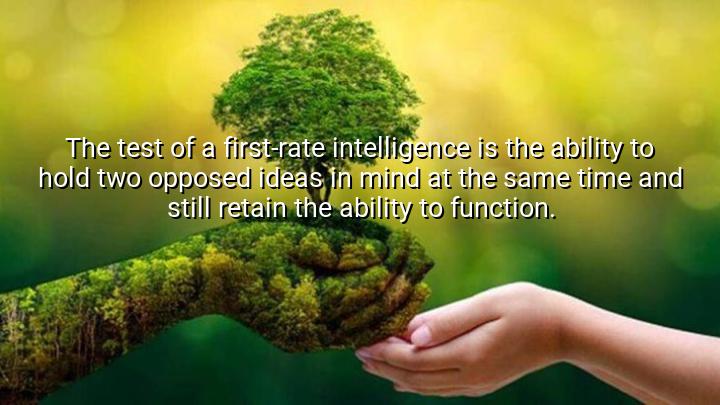




The quote "The test of a first-rate intelligence is the ability to hold two opposed ideas in mind at the same time and still retain the ability to function" by F. Scott Fitzgerald suggests that true intelligence involves a balance of complexity and critical thinking. Fitzgerald, known for his works such as The Great Gatsby, believed that the ability to simultaneously entertain contradictory ideas and navigate them without becoming paralyzed by confusion was a key sign of intellectual maturity. Rather than relying on simple, black-and-white thinking, a person with first-rate intelligence is capable of holding tension between opposing thoughts and still acting decisively.
This quote speaks to the concept of cognitive dissonance, where two conflicting ideas or beliefs exist simultaneously in the mind. Fitzgerald suggests that a highly intelligent person doesn’t necessarily need to resolve these contradictions immediately but can function effectively even in the face of uncertainty or ambiguity. This level of intellectual agility allows for a more nuanced understanding of the world, where complexity and contradictions are not seen as barriers, but as aspects of reality that can be integrated into decision-making.
The origin of this quote reflects Fitzgerald’s own exploration of human nature and the complexities of life, particularly in his depiction of the Jazz Age and its characters. His writing often delved into themes of disillusionment, contradiction, and the tension between idealism and reality. This quote aligns with his belief that the most insightful individuals are those who can navigate the complexities of life without being overwhelmed by them, showing that intelligence is as much about flexibility and adaptability as it is about knowledge.
Ultimately, Fitzgerald’s quote encourages us to embrace complexity and ambiguity rather than avoid them. It suggests that true intelligence is not just about solving problems but about the ability to engage with the contradictions and paradoxes of life, all while maintaining the ability to function effectively. It challenges us to cultivate a mindset that can thrive in uncertainty, seeing it not as a hindrance, but as an opportunity for deeper understanding and growth.

AAdministratorAdministrator
Welcome, honored guests. Please leave a comment, we will respond soon