

The strangest thing that human speech and human writing can do is create a metaphor. That is an amazing leap, is it not?
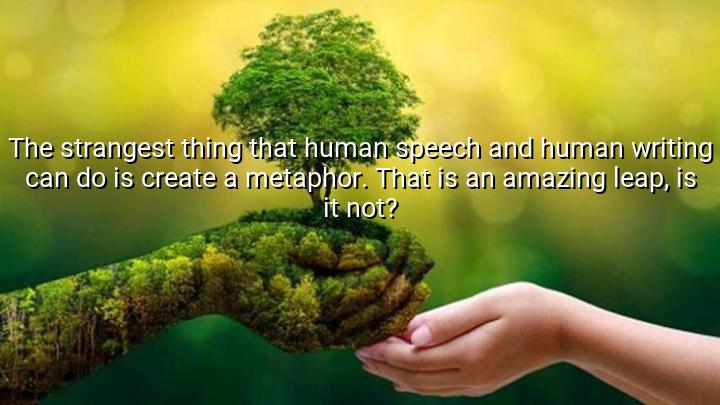




In the quote, "The strangest thing that human speech and human writing can do is create a metaphor. That is an amazing leap, is it not?" Dennis Potter is reflecting on the power and complexity of language, specifically the act of creating metaphors. He points out that metaphors—where one thing is used to represent another—are an extraordinary feature of human communication. The ability to take abstract or complex ideas and express them in a way that resonates deeply with others is a unique and profound aspect of speech and writing.
By describing the creation of a metaphor as "an amazing leap," Potter is highlighting the mental and linguistic jump that occurs when we use figurative language to convey something beyond the literal meaning of words. Metaphors enable people to understand abstract concepts, emotions, and experiences by linking them to more tangible or familiar ideas, thus allowing for deeper connections and richer communication.
Potter’s observation underscores the transformative power of human speech and writing. While many aspects of language are functional, the ability to use metaphors elevates language to a creative and intellectual tool that shapes how we think and express ourselves. This "amazing leap" is something that sets human communication apart from other forms of animal communication, where the use of metaphor is not present in the same way.
Ultimately, Dennis Potter is marveling at the cognitive and linguistic capacity of humans to use language in such an imaginative and meaningful way. His words encourage us to appreciate the complexity of communication and the unique ability we have to craft metaphors that allow us to transcend the limits of literal language and connect with others on a deeper, more emotional level.

TTHa Thu Thuy
I’d love to explore how different fields—like science, philosophy, and psychology—use metaphors to explain difficult concepts. Does metaphor serve as a bridge between abstract theory and human experience? Dennis Potter’s observation highlights metaphor as a uniquely human tool that expands our intellectual and emotional horizons.
TLthanh le
This quote also raises questions about the potential limits of metaphor. While powerful, can metaphors sometimes mislead or oversimplify complex realities? How do we balance the poetic beauty of metaphor with the need for clarity and precision in communication? It’s a reminder that language, while creative, must also be responsible and effective.
QTQuoc Thinh
Dennis Potter’s statement prompts me to reflect on how metaphors influence art, literature, and everyday communication. How do metaphors enrich storytelling and help convey universal truths? Are some metaphors culturally specific, or do certain ones resonate universally across languages and societies? Understanding this might deepen our appreciation for linguistic creativity.
GBnguyen le gia bao
I’m intrigued by the idea that metaphor represents a ‘strange’ leap. Why do you think it feels so extraordinary compared to literal language? Could it be that metaphors allow us to express emotions and experiences that are otherwise inexpressible? This challenges us to appreciate not just the mechanics of language but its profound artistic and psychological dimensions.
TGLe Truong Giang
This quote makes me wonder about the cognitive process behind creating and interpreting metaphors. How does the brain link seemingly unrelated concepts to generate new meaning? Is this ability unique to humans, and what does it say about our creativity and intelligence? Exploring the nature of metaphor could reveal much about language’s power and its role in shaping culture.