

The spirituality of the music is something that I always search for in what I do, because I think that music has to have everything inside: a strong architecture, a support, the emotion.
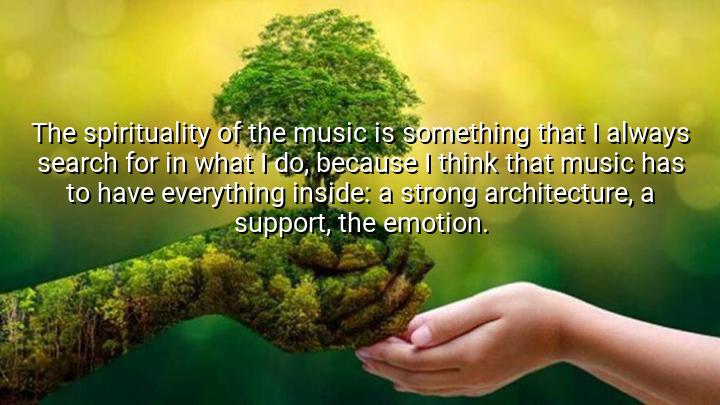




The quote by Ludovico Einaudi, "The spirituality of the music is something that I always search for in what I do, because I think that music has to have everything inside: a strong architecture, a support, the emotion," reveals his deep and intentional approach to musical composition. Einaudi, a renowned Italian pianist and composer known for his minimalist and emotionally resonant works, describes music as a spiritual journey—an art form that must encompass both structure and feeling to truly resonate with listeners.
By referring to architecture in music, Einaudi highlights the importance of form, balance, and structure in creating a piece that holds together coherently. Just as a building must have a solid foundation and thoughtful design, music too requires a framework that supports its emotional depth. The "support" he speaks of suggests an underlying technical precision that allows the melody, harmony, and rhythm to flow naturally and meaningfully.
Einaudi’s emphasis on emotion and spirituality points to his belief that music must go beyond technical brilliance—it must touch the soul. His compositions often evoke introspection, peace, and connection, drawing listeners into a meditative experience. This emotional component, combined with strong architectural underpinnings, is what gives his music its unique universality and intimacy.
Ultimately, the quote encapsulates Einaudi’s artistic philosophy: that great music is a synthesis of structure and sensation, discipline and inspiration. His work reminds us that music, like architecture, is not only about construction but about creating spaces—internal and external—where people can feel, reflect, and connect.

TTtuyen tran
This quote touches on a profound idea: that music, to be complete, must have structure, support, and emotional depth. But what about improvisation, like in jazz or live performances? Does that spontaneity challenge the need for a fixed 'architecture'? Can spiritual resonance come from the freedom of breaking structure rather than building it? I think there’s room for both, but I’m curious how Einaudi would see that contrast.
VVvan van
There’s something powerful about thinking of music as architecture—emotion resting on a carefully built framework. But does every genre or piece require this same balance? I’m wondering if certain musical styles prioritize one element over the other intentionally. For instance, do electronic or ambient genres aim for emotional atmosphere more than architectural complexity? Would love a discussion on how this idea applies across different musical traditions.
KNKhanh Ngoc
Einaudi’s words really make me reflect on why some music gives me goosebumps while other pieces, even if technically brilliant, leave me cold. Is the ‘spirituality’ he refers to something that can be taught, or is it inherently personal and intuitive? How do you even define that spiritual element in sound? I’d love to hear how different composers interpret that search in their own work.
TDThuy Duong
I resonate deeply with the idea that music should carry both structure and emotion. But how does one balance these two without one overpowering the other? Is it possible for a composition to be emotionally intense yet structurally weak—or vice versa? This makes me think of minimalist music, like Einaudi's own work, and how it often finds that delicate balance. I’d be curious to know how he approaches that balance during his creative process.
TTLuong Ta Thi
It’s fascinating how Einaudi links music with architecture—it makes me wonder how much structure actually influences emotional depth in composition. Can a piece really move someone deeply without a solid underlying framework? Or is it sometimes the rawness and imperfection that creates the most powerful experience? I’d love to hear examples of music that feel spiritually resonant yet break away from traditional architectural principles.