

The ruler who possesses methods of government does not follow the good that happens by chance but practices according to necessary principles. Law, methods, and power must be employed for government: these constitute its 'necessary principles.'
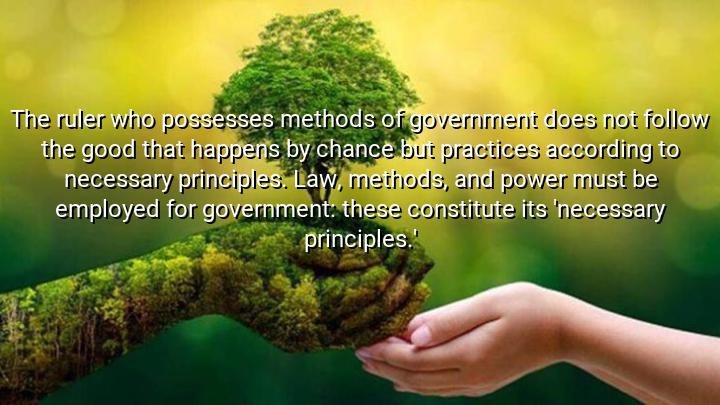




The quote "The ruler who possesses methods of government does not follow the good that happens by chance but practices according to necessary principles. Law, methods, and power must be employed for government: these constitute its 'necessary principles.'" comes from Han Fei, an influential Chinese philosopher of the Legalist school during the Warring States period (circa 280–233 BCE). In this statement, Han Fei emphasizes that effective governance should not depend on chance or lucky circumstances but must be grounded in consistent and deliberate principles.
The meaning behind the quote lies in Han Fei’s belief that strong, stable rule requires law, methods, and power working together. By warning rulers not to rely on “the good that happens by chance,” he rejects arbitrary decision-making and the hope that favorable conditions will simply appear. Instead, he advocates for a structured system in which laws are clearly defined, administrative methods are consistent, and the ruler maintains firm authority. These necessary principles are meant to ensure order, predictability, and control in the state.
The origin of this perspective is rooted in Legalism, a Chinese political philosophy that arose during a time of constant warfare and political instability. Han Fei, building on the work of earlier thinkers like Shang Yang, argued that human nature was inherently self-interested and that only strict laws, effective bureaucracy, and concentrated power could ensure loyalty and prevent chaos. His writings, later compiled into the text Han Feizi, became highly influential in shaping the governance of the Qin dynasty, which eventually unified China.
Ultimately, Han Fei’s words reflect a pragmatic and disciplined approach to leadership. By insisting that rulers depend on principles rather than chance, he sought to create a model of governance resistant to instability and personal whim. His advice underscores the Legalist conviction that the durability of a state rests not on the ruler’s luck or benevolence, but on an unwavering framework of law, administrative order, and political authority.

AAdministratorAdministrator
Welcome, honored guests. Please leave a comment, we will respond soon