

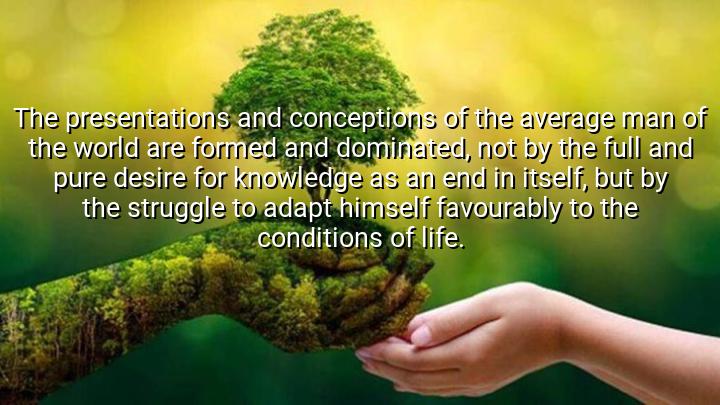
The presentations and conceptions of the average man of the world are formed and dominated, not by the full and pure desire for knowledge as an end in itself, but by the struggle to adapt himself favourably to the conditions of life.
The presentations and conceptions of the
The presentations and conceptions of the average man of the world are formed and dominated, not by the full and pure desire for knowledge as an end in itself, but by the struggle to adapt himself favourably to the conditions of life.

The presentations and conceptions of the
The presentations and conceptions of the average man of the world are formed and dominated, not by the full and pure desire for knowledge as an end in itself, but by the struggle to adapt himself favourably to the conditions of life.
The presentations and conceptions of the
The presentations and conceptions of the average man of the world are formed and dominated, not by the full and pure desire for knowledge as an end in itself, but by the struggle to adapt himself favourably to the conditions of life.
The presentations and conceptions of the
The presentations and conceptions of the average man of the world are formed and dominated, not by the full and pure desire for knowledge as an end in itself, but by the struggle to adapt himself favourably to the conditions of life.
The presentations and conceptions of the
The presentations and conceptions of the average man of the world are formed and dominated, not by the full and pure desire for knowledge as an end in itself, but by the struggle to adapt himself favourably to the conditions of life.
The presentations and conceptions of the

The quote by Ernst Mach reflects on the nature of human understanding and the motivations behind acquiring knowledge. Mach suggests that the average person does not pursue knowledge purely for its own sake, but rather in relation to practical concerns. This emphasizes that most human cognition is instrumental, aimed at navigating life and adapting to social, economic, or environmental conditions.

Mach highlights that our perceptions and conceptions are shaped by the need to adapt favorably to circumstances rather than by a detached or idealistic pursuit of truth. In other words, knowledge is often valued not for its intrinsic worth but for its utility in achieving personal or collective goals. This perspective underscores the pragmatic dimension of human thought and learning.

The origin of this statement comes from Mach’s work as a philosopher and physicist, particularly in his explorations of empiricism and scientific philosophy. Mach was concerned with how human perception and scientific understanding are influenced by practical experiences and the ways in which knowledge serves as a tool to interpret and respond to the world.

In essence, the quote emphasizes the practical orientation of human knowledge. Mach reminds us that while humans may aspire to intellectual pursuit, much of our learning and reasoning is motivated by the desire to survive, succeed, and adapt, illustrating the close relationship between cognition and the demands of everyday life.

Have 0 Comment The presentations and conceptions of the

AAdministratorAdministrator

Welcome, honored guests. Please leave a comment, we will respond soon

Reply.
Information sender
Leave the question
Click here to rate
Information sender
0.19270 sec| 2553.547 kb