

The past, like the future, is indefinite and exists only as a spectrum of possibilities.
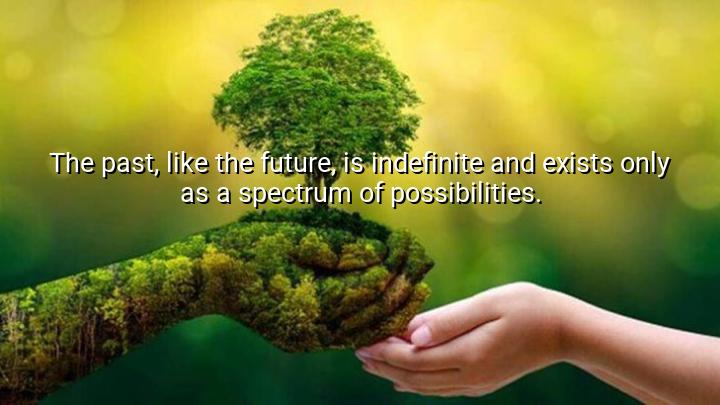




The quote "The past, like the future, is indefinite and exists only as a spectrum of possibilities" is attributed to Stephen Hawking, one of the most renowned theoretical physicists of the 20th and 21st centuries. In this statement, Hawking emphasizes the uncertainty of both the past and the future, suggesting that neither is set in stone. While we may think of the past as something fixed and determined, Hawking proposes that it, too, is subject to interpretation and change, much like the future, which is often seen as full of potential outcomes.
Hawking’s words challenge the traditional notion of time as a linear progression from the past through the present and into the future. Instead, he suggests that both the past and future are best understood as a range of possibilities. This aligns with his work in cosmology and quantum mechanics, where the concepts of time and space are often seen as more fluid and subject to the laws of physics that govern the universe. In this view, events that have already occurred are not necessarily fixed, but rather part of a broader spectrum that could have unfolded differently.
The idea that the past exists only as a spectrum of possibilities also reflects the human experience of memory and interpretation. Our understanding of past events is often shaped by our perceptions and biases, meaning that different people might remember or interpret the same event in different ways. Similarly, the future remains a field of uncertainty, with infinite paths that can be shaped by the decisions we make in the present.
Ultimately, Stephen Hawking’s quote reflects his broader philosophical and scientific perspective on the nature of time, emphasizing that both the past and the future are not as fixed as they might seem. By viewing them as possibilities, he encourages a deeper understanding of the fluidity of time and the role that human choice, perception, and scientific principles play in shaping our experience of the world.

AAdministratorAdministrator
Welcome, honored guests. Please leave a comment, we will respond soon