

The only thing that holds true happiness is that moment when you're in it. Nothing can be controlled.
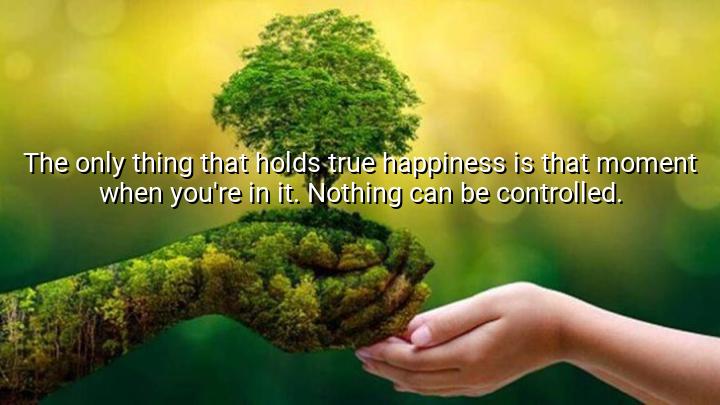




In this quote, Eliza Doolittle reflects on the transient nature of happiness. She suggests that true happiness is not something that can be held onto or controlled but is found in the fleeting moments when we are fully immersed in the experience of being happy. Doolittle emphasizes that happiness cannot be sustained through force or planning; it is a state that arises spontaneously, often when we least expect it. This captures the idea that the essence of happiness is not about possessing it, but about experiencing it in the present moment.
Doolittle's statement challenges the idea that happiness is something we can control through external circumstances or material achievements. Instead, she advocates for the acceptance that happiness is an unpredictable and temporary state, best appreciated when we are in the middle of it. Her words reflect the belief that we should cherish the moments of joy as they come, without trying to hold onto them or force them to last forever.
The origin of the quote can be traced to Eliza Doolittle, a character from George Bernard Shaw’s play Pygmalion (later adapted into the musical My Fair Lady). Eliza's character evolves throughout the story, learning about self-worth, social class, and personal growth. Her comment here reflects a deeper understanding of life's impermanence and the fragility of happiness, which she comes to realize during her personal transformation.
Ultimately, Doolittle’s words remind us that happiness is not something to be possessed or controlled, but something to be experienced in the moment. By letting go of the need to hold onto happiness and accepting its fleeting nature, we can fully appreciate the joy we encounter in life.

AAdministratorAdministrator
Welcome, honored guests. Please leave a comment, we will respond soon