

The only business of the head in the world is to bow a ceaseless obeisance to the heart.
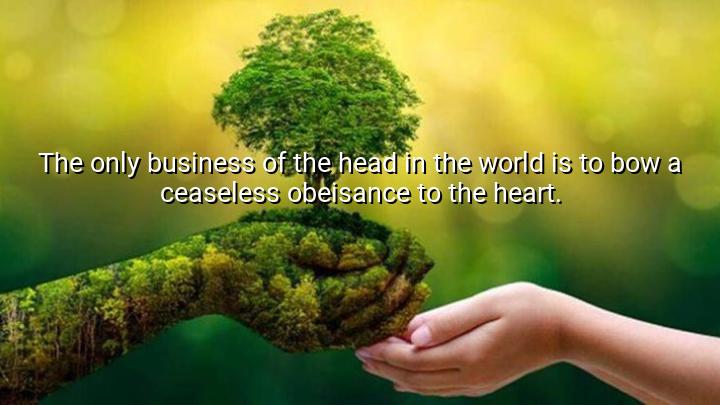




The quote “The only business of the head in the world is to bow a ceaseless obeisance to the heart” by William Butler Yeats reflects a profound philosophical stance on the relationship between reason and emotion. In this poetic statement, Yeats suggests that the intellect—symbolized by the “head”—should ultimately serve and submit to the emotions, intuition, and passions of the “heart.” Rather than allowing logic to dominate our decisions and values, he advocates for a worldview where feeling, love, and spiritual insight hold the higher authority.
This quote is rooted in Yeats’s broader body of work, which often grappled with the tension between rationality and mysticism, as well as between the modern mind and ancient traditions. As an Irish poet and a leading figure in the symbolist and romantic revival movements, Yeats frequently exalted the role of emotion, imagination, and artistic vision in both personal and societal transformation. He believed that the soul’s truth could not be fully grasped through analytical thought alone.
By declaring that the head’s only “business” is to “bow” to the heart, Yeats is challenging the modern preoccupation with rationalism and intellectual supremacy. The phrase “ceaseless obeisance” underscores a call for humility—a continuous, reverent submission of mind to emotion, of thought to feeling. This poetic expression advocates for a life led by authenticity, compassion, and inner truth, rather than cold calculation.
Ultimately, this quote serves as a call to restore balance between our rational and emotional selves, suggesting that true wisdom lies in recognizing the primacy of the heart. In Yeats’s poetic and mystical worldview, it is through the heart—not the head—that we find meaning, connection, and beauty in life.

AAdministratorAdministrator
Welcome, honored guests. Please leave a comment, we will respond soon