

The more people who are dependent on government handouts, the more votes the left can depend on for an ever-expanding welfare state.
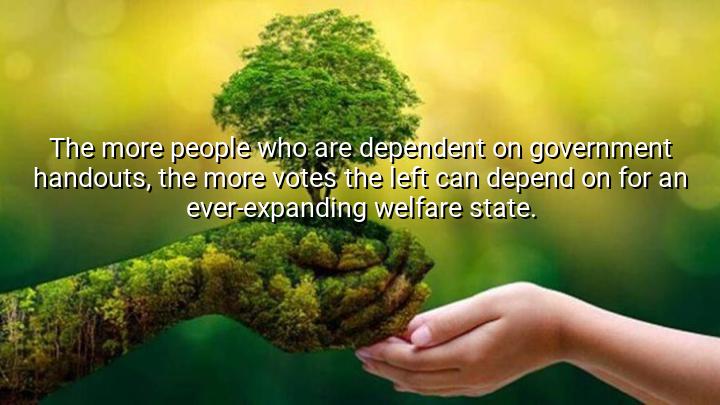




Thomas Sowell’s quote, "The more people who are dependent on government handouts, the more votes the left can depend on for an ever-expanding welfare state," critiques the relationship between government assistance programs and political power. Sowell suggests that as more individuals rely on welfare and government support, political parties, particularly those on the left, gain greater leverage in securing votes. His statement implies that the expansion of government benefits can lead to a cycle where political parties that promote these programs gain support from those who depend on them.
The origin of this quote lies in Sowell’s conservative views on government intervention and welfare. As an economist and political commentator, Sowell has often criticized policies that he believes create dependency on the state rather than encouraging self-sufficiency and personal responsibility. His criticism is particularly aimed at what he sees as the left’s tendency to expand the welfare state, believing that it may perpetuate dependency rather than solving the root issues of poverty and inequality.
Sowell’s argument is grounded in his belief that expanding the welfare state leads to an erosion of individual initiative and long-term economic prosperity. By making more people dependent on government handouts, he argues, politicians secure a voting base that supports the expansion of such programs. This dynamic creates a feedback loop in which political parties that rely on these votes may continue to increase welfare provisions, perpetuating the cycle of dependence and expanding the welfare state.
In essence, Sowell’s quote expresses concern about the long-term effects of government handouts on both individuals and society as a whole. He suggests that while these programs are often framed as solutions to social problems, they may inadvertently create a political system that benefits from dependency rather than fostering independence and economic mobility. This reflects his broader critique of welfare programs and their impact on both political dynamics and the economic well-being of the nation.

AAdministratorAdministrator
Welcome, honored guests. Please leave a comment, we will respond soon