

The learning and knowledge that we have, is, at the most, but little compared with that of which we are ignorant.
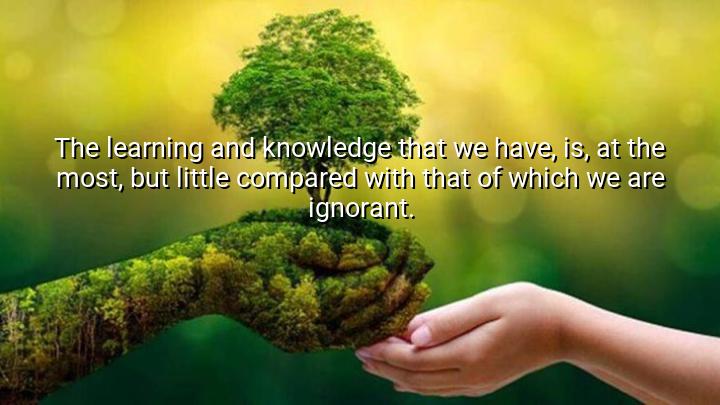




The quote, “The learning and knowledge that we have, is, at the most, but little compared with that of which we are ignorant,” is attributed to Plato, the ancient Greek philosopher and student of Socrates. Plato often explored the limits of human understanding, emphasizing humility in the pursuit of knowledge. This statement reflects his belief that no matter how much we learn, the vastness of what remains unknown will always far outweigh what we grasp.
The first part, “the learning and knowledge that we have,” acknowledges the progress of human inquiry. While we may acquire insights in philosophy, science, and daily life, these accomplishments are relatively small when placed against the infinite complexity of existence. Plato suggests that knowledge should inspire curiosity rather than pride.
The second part, “compared with that of which we are ignorant,” highlights the boundless scope of human ignorance. For Plato, true wisdom comes from recognizing how little we actually know. This idea echoes his teacher Socrates, who famously declared that wisdom begins in admitting one’s ignorance. Such acknowledgment is not defeat but the starting point of deeper philosophical inquiry.
Ultimately, this quote serves as a timeless reminder of intellectual humility. Plato encourages us to see learning as a lifelong process, where each discovery only reveals how much more there is to uncover. In recognizing the limits of our knowledge, we remain open to growth, wonder, and the continuous search for truth.

AAdministratorAdministrator
Welcome, honored guests. Please leave a comment, we will respond soon