

The knower and the known are one. Simple people imagine that they should see God as if he stood there and they here. This is not so. God and I, we are one in knowledge.
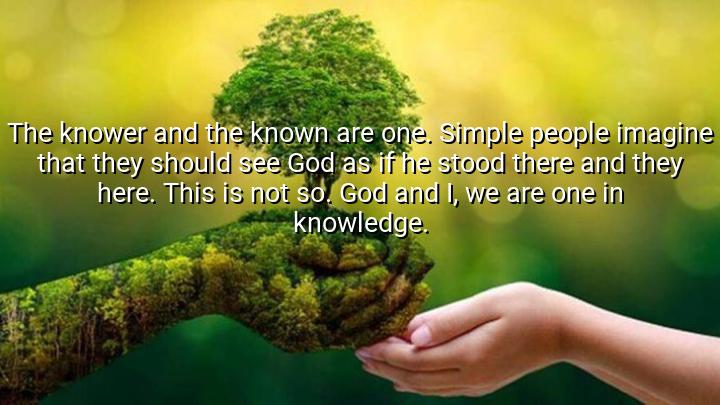




The quote, “The knower and the known are one”, originates from the teachings of Meister Eckhart, a 13th–14th century German Christian mystic, philosopher, and theologian. His writings emphasize a direct, inner experience of God beyond traditional dogma. In this passage, he challenges the dualistic view that places God as a separate being “over there” and humans “over here.” Instead, he asserts that true knowledge of God arises from unity, where the subject (the knower) and the object (the known) are not divided.
The meaning lies in the mystical idea of oneness. When Eckhart says “God and I, we are one in knowledge,” he points to the dissolution of the boundary between human perception and divine reality. This reflects the notion that to truly know God is not to observe Him as something external, but to recognize that the very act of knowing arises from the same divine source. In other words, knower, knowing, and known are all inseparable in the experience of God.
The quote also draws from traditions of mystical union, resonating with both Christian theology and parallels in other spiritual paths, such as Hindu Vedanta and certain strands of Sufism. For Eckhart, knowledge of God is not intellectual but experiential—it is a direct participation in being itself, where human consciousness merges with divine reality.
Ultimately, this teaching encourages believers to move beyond simplistic or dualistic imaginations of God as a distant figure. Instead, it invites an inward journey of realization, where God is experienced as the very ground of one’s own awareness. In this sense, Eckhart’s mystical vision reframes knowledge as unity, dissolving separation and revealing the divine at the core of human existence.

AAdministratorAdministrator
Welcome, honored guests. Please leave a comment, we will respond soon