

The illusion of purpose and design is perhaps the most pervasive illusion about nature that science has to confront on a daily basis.
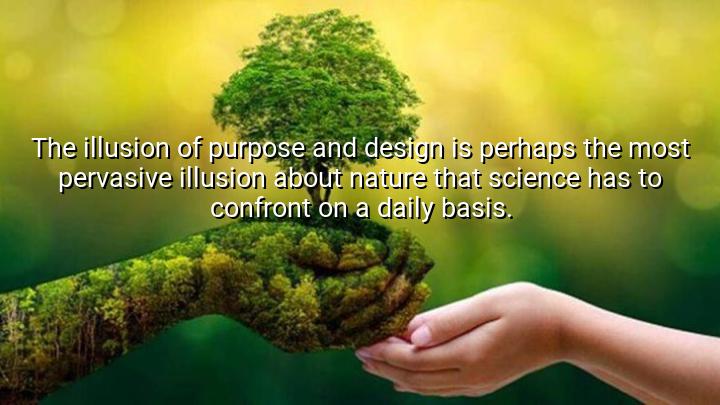




Lawrence M. Krauss’s quote highlights the challenge science faces in countering the deeply rooted belief that nature operates with purpose and design. By calling this belief an “illusion,” he suggests that while the natural world may appear orderly and purposeful, its complexity arises from physical laws, chance, and evolutionary processes—not from intentional planning. This reflects a scientific perspective that seeks to explain the universe through evidence rather than through assumptions of teleology or divine design.
The meaning of the statement lies in its challenge to human perception. People naturally look for patterns and meaning, often attributing purpose to natural phenomena, from the shape of galaxies to the behavior of living organisms. Krauss argues that this tendency is misleading, because it imposes human-like intention on processes that are inherently indifferent. For scientists, confronting this misconception is crucial to understanding reality as it is, rather than as we want it to be.
The origin of this quote comes from Krauss’s work as a theoretical physicist and science communicator. Known for books such as A Universe from Nothing and The Physics of Star Trek, he often addresses questions of cosmology, evolution, and the philosophy of science. His reflections on purpose and design stem from his efforts to promote scientific literacy and to combat pseudoscience and misconceptions about the natural world.
Ultimately, Krauss’s words underscore the tension between scientific explanations and human tendencies toward meaning-making. His quote serves as a reminder that while the universe may seem to exhibit design, its apparent order can be explained through natural laws and processes without invoking external purpose. In doing so, he challenges us to embrace the beauty of a universe that is both complex and fundamentally indifferent.

AAdministratorAdministrator
Welcome, honored guests. Please leave a comment, we will respond soon