

The Green Climate Fund is very much a strategic building block in the architecture for financing sustainable development.
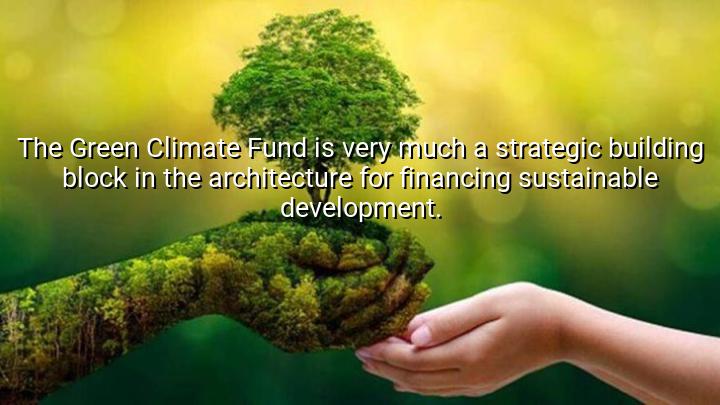




Isabella Lövin’s quote highlights the critical role of the Green Climate Fund (GCF) in shaping the global financial system for sustainable development. By calling it a “strategic building block,” she emphasizes that the GCF is not just a funding mechanism but a foundational component of a larger financial architecture designed to support climate action and low-carbon development worldwide. This metaphor suggests that without such strategic pieces, the broader structure of global sustainability financing would be incomplete or unstable.
The phrase “architecture for financing sustainable development” refers to the system of institutions, frameworks, and policies that guide how climate-related projects are funded, particularly in developing countries. Lövin underscores that the GCF plays a central role in this ecosystem by mobilizing resources, channeling public and private investments, and supporting countries in meeting their climate adaptation and mitigation goals under the Paris Agreement. It represents an effort to build a cohesive and effective financial infrastructure that supports equitable and long-term environmental progress.
Lövin’s statement reflects her broader commitment to climate policy and international cooperation. As a Swedish politician and former Minister for International Development Cooperation and Climate, she has been actively involved in global discussions on how to make climate finance more accessible, transparent, and impactful. Her advocacy positions the GCF as a tool not just for distributing money, but for strategically influencing the future of sustainable development financing.
The quote originates from public addresses and policy discussions in which Isabella Lövin spoke on the importance of international climate funds. Her words stress that climate finance isn't merely a technical concern—it is part of a larger strategic framework for transforming the global economy to become more resilient, inclusive, and environmentally responsible. The GCF, as she suggests, is a keystone in that architecture, helping bridge the gap between ambition and implementation on a global scale.

AAdministratorAdministrator
Welcome, honored guests. Please leave a comment, we will respond soon