

The great object of the institution of civil government is the improvement of those who are parties to the social compact.
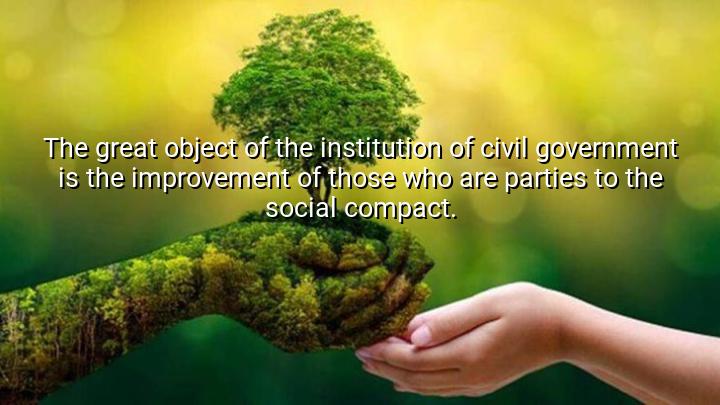




The quote by John Quincy Adams emphasizes the primary purpose of civil government, which he believes is the improvement of the individuals who are part of the social compact. The social compact refers to the idea that individuals agree to form a government in order to create a structured society, governed by laws and mutual respect. According to Adams, the role of government is not only to maintain order and provide security but also to help its citizens grow and develop, both morally and socially. Government should foster an environment where individuals are encouraged to improve themselves and contribute to the common good.
John Quincy Adams, the 6th President of the United States, was a firm believer in the ideals of self-government and moral improvement. This quote reflects his belief that government should serve a greater purpose than just enforcing laws—it should actively contribute to the betterment of society by guiding its people toward higher moral standards and providing opportunities for personal growth. This concept aligns with his broader political philosophy, which emphasized the responsibility of the government to promote virtue and education among its citizens.
The origin of this quote lies in Adams's broader political thought, which was influenced by the Enlightenment ideals of reason and progress. He believed that democracy and liberty could only thrive in a society where individuals were committed to moral improvement and the collective welfare. In his view, the social compact—the agreement to live together under shared laws—was a means of promoting not just social order but the overall advancement of society through educational and civic participation.
In a broader context, Adams's words highlight the enduring idea that the purpose of government should extend beyond maintaining peace and security. His quote suggests that a just government is one that actively seeks to nurture the moral and intellectual growth of its people, helping them to lead better lives and contribute to a flourishing society. This perspective remains relevant in modern discussions about the role of government in social welfare, education, and civic engagement.

AAdministratorAdministrator
Welcome, honored guests. Please leave a comment, we will respond soon